
The government has now filled in much more of the detail behind its Warm Homes Plan, and if you are thinking about solar panels, a battery, insulation or a heat pump, it is worth understanding what has changed.
The headline numbers are certainly impressive. The government plans £15 billion of public investment, intended to upgrade up to five million homes by 2030 and lift up to a million families out of fuel poverty. But those numbers do not answer the question that matters when you are sitting at home in East Yorkshire wondering whether to replace a boiler, insulate the house or put solar panels on the roof:
Can I actually get any of this money?
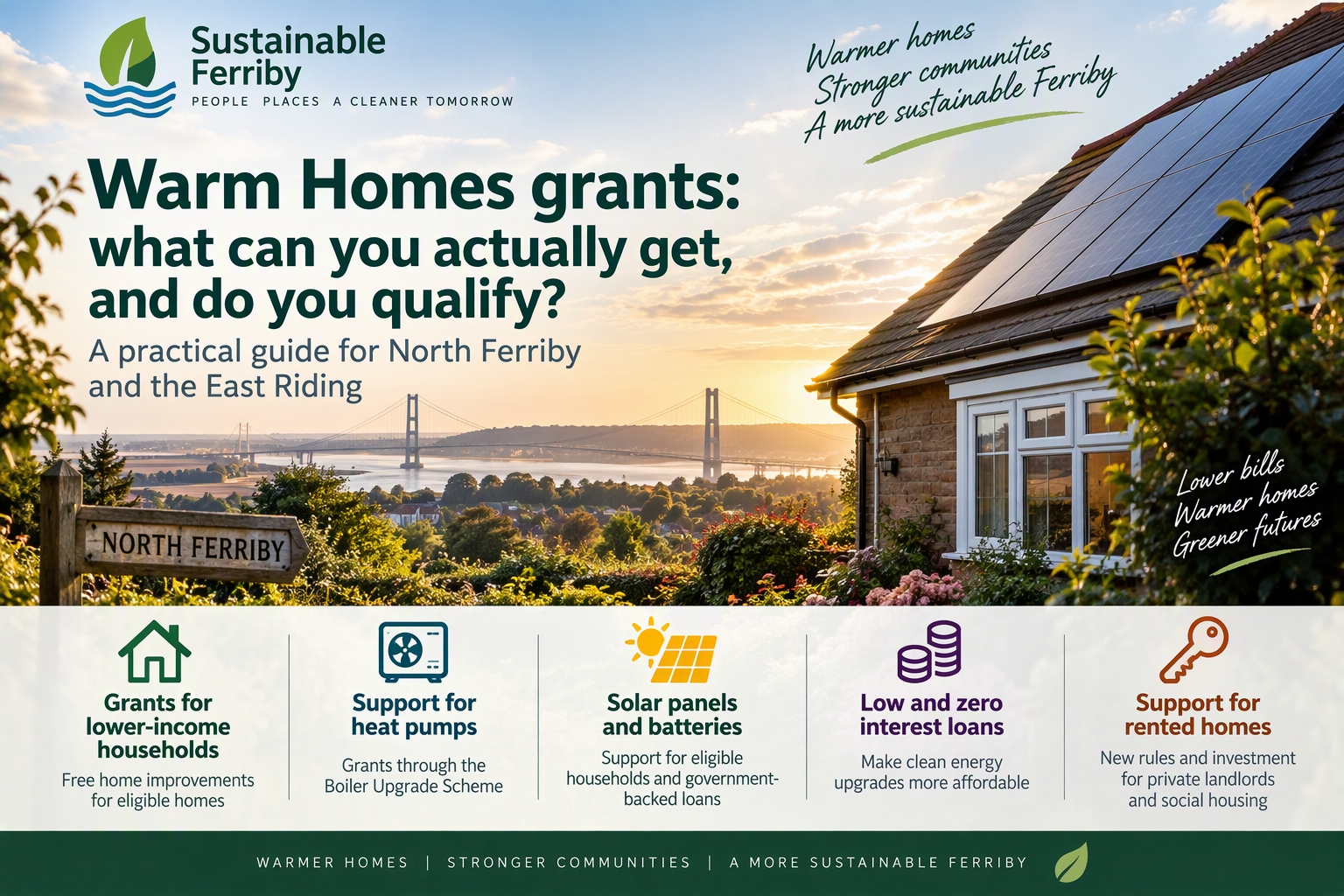
The answer is quite possibly yes, but not necessarily as a grant. The Warm Homes Plan is actually a collection of different kinds of support, ranging from completely free improvements for some lower-income households to grants for heat pumps and government-backed low and zero-interest loans for solar panels, batteries and other technologies.
The easiest way to understand it is to start with your circumstances rather than the name of the scheme.
Are you on a lower income?
If you live in a privately owned home in England, including a privately rented home, the first scheme to look at is the Warm Homes: Local Grant.
This provides free energy-saving improvements to qualifying households. Your property must normally have an Energy Performance Certificate, or EPC, rating of D, E, F or G. Your household income will usually need to be £36,000 a year or less, although households with a higher income can sometimes qualify because of where they live or because somebody in the household receives certain benefits.
If you do not know the EPC rating of your house, that need not stop you applying. The government application process specifically says this can be established as part of the process.
If you qualify, a survey is used to determine which improvements are appropriate for the property. These can include:
- wall, loft and underfloor insulation;
- air-source heat pumps;
- smart heating controls;
- solar panels;
- other appropriate energy-efficiency improvements.
Importantly, this is not simply a voucher towards work you then have to organise yourself. The local authority arranges the agreed improvements and pays for them. For an eligible owner-occupier, the government guidance says you do not have to pay for the agreed work. Different rules can apply to landlords.
That makes it well worth checking even if you assume you are unlikely to qualify.
What if my income is above £36,000?
Don’t immediately give up.
The £36,000 figure is the usual income threshold, rather than an absolute cut-off for every household. The scheme has several eligibility routes, including qualifying benefits and specified lower-income postcode areas. The detailed government guidance provides different pathways by which a household may be identified as eligible.
The rule is:
If your home is EPC D to G and you think you may be on the borderline, check rather than excluding yourself.
The national eligibility service will direct an application to the appropriate council.
What if I want a heat pump?
There is a completely different route for many households considering a heat pump.
The Boiler Upgrade Scheme is not restricted to lower-income households in the way that the Warm Homes: Local Grant is.
The government’s Warm Homes programme continues substantial grant support for low-carbon heating, and the latest government information says homeowners can combine an eligible Warm Homes loan with a Boiler Upgrade Scheme grant, depending on the installation and eligibility. The standard grant is £7,500 for an eligible air-to-water, ground-source or water-source heat pump in England and Wales. A higher £9,000 rate is not the general heat-pump grant: it applies only to eligible off-gas-grid properties replacing heating oil or LPG with an air-to-water or ground-source heat pump, from 21 July 2026 to 31 March 2027. Eligible air-to-air heat pumps receive £2,500 and eligible biomass boilers £5,000.
Before choosing a heat pump, however, the important question isn’t simply whether you can get a grant. The system needs to be properly designed for the house. Heat loss, radiator or emitter sizing, hot-water requirements and achievable flow temperatures all matter. A badly designed heat-pump installation with a generous grant is still a badly designed heating system.
Boiler Upgrade Scheme applications are installer-led: your installer applies for the grant on your behalf, and must be appropriately MCS-certified. For grant-supported installations requiring MCS certification, use an appropriately certified installer and look at the whole-house design rather than simply shopping for the cheapest heat pump.
What if I want solar panels or a battery?
This is where the new arrangements become particularly interesting.
For lower-income households qualifying for the Warm Homes: Local Grant, solar PV can be one of the measures installed free of charge where it is appropriate for the property.
For everyone else, government is not offering a universal “free solar panel grant”. Instead it has introduced the Warm Homes Loan Scheme, providing government-backed low and zero-interest finance for technologies including:
- solar panels;
- home batteries;
- heat pumps.
That distinction is important because we’ve already seen rather loose descriptions of the Warm Homes Plan as though everyone is suddenly eligible for a solar grant. They aren’t.
But the availability of cheaper finance potentially changes the economics for people who would otherwise have to delay an installation while they saved the capital.
The new Warm Homes loans
This was announced early this year, but the detail emerged a couple of weeks ago.
The government says the new loans require no upfront cost and can spread payments over many years. It has worked with lenders to provide an interest-rate reduction of up to 5% compared with their normal loans, although the actual rate and conditions will depend on the lender and the borrower.
Some participating products are interest-free and repayment periods can extend to as much as 30 years.
At launch, the government named ten participating lenders:
- HomeServe, partnering with E.ON;
- Hometree Finance;
- Propensio;
- Secure Trust Bank;
- Selina Finance;
- South Manchester Credit Union;
- Sunsave;
- Tandem Bank;
- The Money Co-op;
- thisbank.
Take note, it’s not free money.
A government-backed loan is still a loan, and the right comparison isn’t simply between the monthly repayment and your current electricity or gas bill. You need to compare the total interest payable, installation cost, likely energy savings, expected lifetime of the equipment and alternative ways of financing the work.
It’s particularly important with solar and batteries, where different combinations of generation, storage, household consumption, electricity tariff and Smart Export Guarantee payments can produce quite different results.
The government’s own example is useful. It considers somebody borrowing £10,000 over seven years at 8%, which it says would mean repayments of around £155 per month with a conventional loan. They say the Warm Homes Loan Scheme could reduce repayments by up to £285 a year in a case like this.
It doesn’t automatically make the investment worthwhile, but it demonstrates what the scheme is trying to do: reduce the financing penalty for households that can afford repayments but don’t have £10,000 or £20,000 sitting in the bank. You can start generating electricity now while paying for the equipment over time.
Whether that makes financial sense depends on the actual loan rate and installation quotation, so do the calculation. It’s possible the savings will be as much as the loan repayment, or at least low enough not to impact your living standards. And once repaid those savings are yours indefinitely.
Can I combine a grant and a loan?
In some circumstances, yes.
Specifically, homeowners can combine a Warm Homes loan with a qualifying Boiler Upgrade Scheme grant, potentially reducing the amount that has to be financed when installing a heat pump.
What if I rent?
The Warm Homes: Local Grant covers qualifying privately owned properties whether they are owner-occupied or privately rented, although landlords may be required to contribute towards improvements in some circumstances.
If you are a tenant, therefore, the starting point is still to check eligibility rather than assuming that only the property owner can benefit.
Social housing follows a different funding route. The wider Warm Homes Plan includes dedicated investment intended to improve social housing as well as privately owned homes.
What about East Riding?
The relevant local authority is East Riding of Yorkshire Council, whose current energy-efficiency information already provides advice on funding and home energy improvements, including assistance for vulnerable households and fully funded insulation measures under some programmes. Its published eligibility criteria for its current loft and cavity-wall scheme include qualifying benefits, properties in Council Tax bands A to D and an EPC rating of D or below.
The council is also actively investing in energy efficiency in its own housing. In October it announced a programme covering more than 300 council homes in the Goole area, including solar PV, improved loft insulation and LED lighting, with the programme expected to be completed by March 2027.
For the Warm Homes: Local Grant itself, however, I would currently use the government’s national application service rather than rely on finding a particular East Riding application page. The GOV.UK service checks eligibility and routes the application to the appropriate council, which will normally contact the applicant within ten working days for further information and, where appropriate, arrange a home survey.
There is also an assisted digital helpline on 0800 098 7950 for people who need help with the application.
Where should I start?
The Warm Homes Plan isn’t one giant pot of money from which everyone gets a grant. It’s really a set of different routes designed for people in quite different circumstances.

The trick is finding the route that applies to you.
And if the answer turns out to be that you’re entitled to several thousand pounds’ worth of improvements to make your home warmer, cheaper to run and lower carbon, that is probably worth a few minutes filling in an online form.
Sources
UK Government – Warm Homes Plan
https://www.gov.uk/government/publications/warm-homes-plan/warm-homes-plan-html
UK Government – Apply for the Warm Homes: Local Grant to improve a home
https://www.gov.uk/apply-warm-homes-local-grant
UK Government – Warm Homes: Local Grant guidance for local authorities
https://www.gov.uk/government/publications/warm-homes-local-grant
UK Government – Warm Homes: Local Grant policy guidance, July 2026
https://assets.publishing.service.gov.uk/media/6a4629fa732d8e7ce5f53b13/warm-homes-local-grant-policy-guidance-july-2026.pdf
UK Government – Warm Homes Loan Scheme: Factsheet
https://www.gov.uk/government/news/warm-homes-loan-scheme-factsheet
UK Government – Warm Homes Loan Scheme: Scheme rules
https://assets.publishing.service.gov.uk/media/6ad7601113c9ff4fd08ed5f5/warm-homes-loan-scheme-rules-sept-2026.pdf
East Riding of Yorkshire Council – Energy efficiency at home
https://www.eastriding.gov.uk/housing/energy-efficiency/energy-efficiency-at-home/
East Riding of Yorkshire Council – Goole homes to have solar panels and improved loft insulation installed
https://www.eastriding.gov.uk/news/article/?entry=goole_homes_to_have_solar_panels_and_improved_loft_insulation_installed
Updated November 2026: the Boiler Upgrade Scheme information in this article has been checked against the current 2026 scheme rules. To be clear, the enhanced £9,000 grant is specifically for qualifying off-gas-grid properties replacing oil or LPG heating; the standard heat-pump grant remains £7,500.