
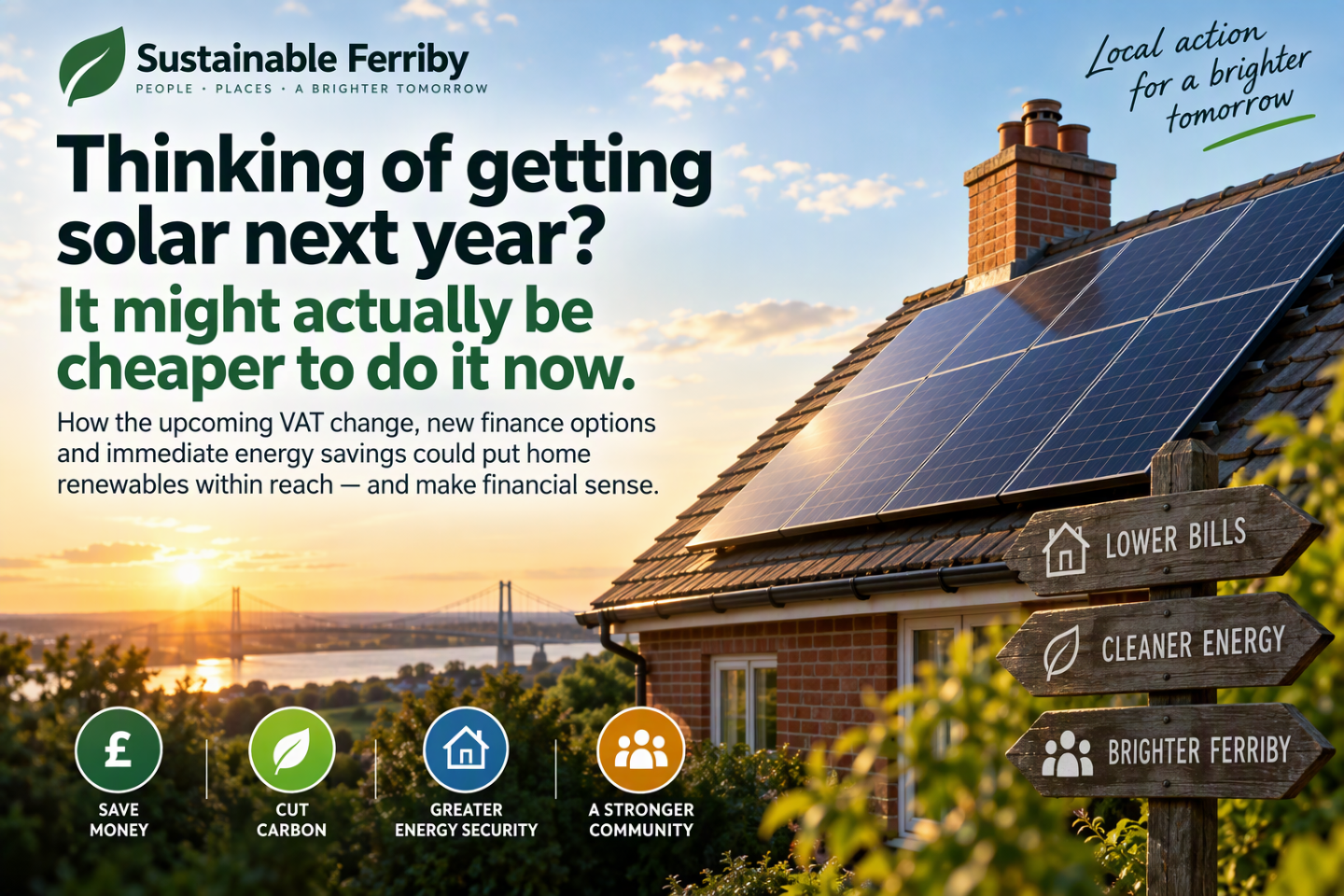
I’ve spoken to quite a few people over the last couple of months who have said they intend to install solar next year, when they can afford it.
My advice is slightly counterintuitive: if you’ve already decided solar is right for your home, it may make more financial sense to do it now, taking a loan if necessary.
The reason? VAT.

After several years of qualifying domestic renewable-energy installations being zero-rated for VAT, that temporary relief ends on 31 March 2027. From 1 April 2027, qualifying energy-saving installations revert to 5% VAT. That includes solar PV and electrical storage batteries. This isn’t speculation about a future Budget: it’s already provided for in the VAT rules. 1 2 3
On a £10,000 solar-and-battery installation, that’s potentially another £500.
But that raises an interesting question. If you haven’t quite saved the £10,000 yet, would it actually make economic sense to borrow the money, install the system now and start enjoying the benefits immediately?
I think that, in some circumstances, the answer is a very definite yes.
First, let’s be clear about the VAT
HMRC currently applies 0% VAT to qualifying installations of energy-saving materials in residential accommodation. That temporary zero rate continues until 31 March 2027, after which qualifying installations revert to the reduced 5% rate. Electrical storage batteries are explicitly included. 1 2
So our illustrative system looks like this:
- Installed before April 2027: £10,000
- Same net price after the VAT change: £10,500
- Difference: £500
Of course, equipment prices might fall or rise in the meantime, so nobody can guarantee that the underlying £10,000 price will remain unchanged. But £500 is our known tax difference. That isn’t the only benefit of installing sooner.
Four months of electricity aren’t worth nothing
Let’s imagine installing in December rather than waiting until April. Admittedly, December to March isn’t the most exciting period for solar generation in, for example, East Yorkshire. But a solar-and-battery installation isn’t simply about generating electricity. With a suitable time-of-use tariff, a battery can also charge when electricity is cheap and supply the house when electricity is expensive. Meanwhile, solar reduces imported electricity and surplus generation can earn export payments.
Current tariffs illustrate just how important this has become. Published 2026 offers include overnight import rates around 8p/kWh, while export rates range enormously and some premium arrangements have offered 18p, 25p or more per kWh. Eligibility conditions vary, which is why choosing a tariff to suit the system matters almost as much as choosing the hardware. 4 5 6
The Government’s new Warm Homes Loan Scheme gives us a useful benchmark. Its October announcement says that solar, battery and heat-pump installations may save a household up to £550 a year, with a time-of-use tariff potentially adding another £300 per year. 7
I’m therefore going to model our £10,000 solar-plus-battery system at £850 per year of combined energy and tariff benefit.
That is deliberately an illustrative scenario, not a promise. Independent calculators produce substantially different figures depending upon household use, system size and assumptions. One current UK calculator, for example, estimates £893 a year for its example £10,000 solar-and-battery installation, while another produces £573 on a more conservative set of assumptions. 8 9
At £850 a year, four months is worth approximately:
£283
So bringing the installation forward by four months has potentially given us:
- £500 VAT avoided
- approximately £283 additional energy/tariff benefit
- total initial economic advantage: approximately £783
But we haven’t paid for the loan yet. Now things get particularly interesting.
Borrowing for renewables has become much cheaper
The arrival of the Warm Homes Loan Scheme changes this calculation quite significantly. The Government says participating lenders can offer rates up to 5% below their normal commercial rates. Ten lenders are participating initially, including Sunsave, Tandem Bank, HomeServe/E.ON, Hometree Finance and Secure Trust Bank, and some products are interest-free. Loans can cover up to £15,000 for solar and £15,000 for batteries. 710
For example, Sunsave currently gives a representative example of 0% APR over 36 months, although that particular illustration is based on borrowing £6,753 rather than our £10,000 example. 11
There are other options.
Nationwide: potentially 0% over five years
For existing mortgage customers, Nationwide’s Green Additional Borrowing is particularly striking.
Eligible borrowers can currently borrow £5,000 to £20,000 at 0% fixed interest for either two or five years, with no product fee. Solar panels and storage are explicitly eligible improvements. The borrowing is secured against the home, and eligibility and loan-to-value requirements apply. 1 2
That means our £10,000 example over five years would cost:
£166.67 per month
Total repaid:
£10,000
Total interest:
£0
For someone who qualifies, avoiding £500 VAT while borrowing at 0% is obviously financially attractive.
Barclays: conventional borrowing at 7.05%
At the other end of the spectrum, we can test whether the argument survives a normal commercial loan.
Barclays Greener Home Loan currently advertises 7.05% representative APR on loans between £7,500 and £15,000 over two to five years, although the actual rate offered depends on personal circumstances. It also offers up to £250 cashback for eligible improvements. 1 3
On £10,000 over five years at 7.05%, my calculation gives:
- Monthly payment: about £198
- Total interest: about £1,895
- Potential cashback: £250
That’s clearly more expensive than 0% finance, but that doesn’t automatically make it a bad decision.
Putting the numbers together
I’ll use the following assumptions throughout:
- Solar and battery system today: £10,000
- Cost after 1 April if the underlying price remains unchanged: £10,500
- Annual energy/tariff benefit: £850
- Four months’ additional benefit from installing early: approximately £283
- Energy prices and tariff benefits held constant for simplicity
- No allowance for inflation
- No allowance for solar degradation
- No allowance for maintenance or battery replacement
- No assumed increase in the value of the house
These are therefore comparative cash figures, not investment forecasts.
£10,000 borrowed now
| Finance example | Loan term | Approx. interest | Energy benefit during loan | Benefit after interest* | Benefit after 10 years* |
|---|---|---|---|---|---|
| Nationwide-style 0% green borrowing | 5 yrs | £0 | £4,250 | £4,250 | £8,500 |
| Illustrative Warm Homes Loan Scheme 3% borrowing | 7 yrs | £1,099 | £5,950 | £4,851 | £7,401 |
| Barclays 7.05% representative loan | 5 yrs | £1,895 | £4,250 | £2,605 | £6,855 |
| Government’s conventional 8% example | 7 yrs | £3,092 | £5,950 | £2,858 | £5,408 |
*These columns show cumulative energy/tariff benefits less financing interest, with the Barclays example also including its £250 eligible cashback. They are not net profit on the solar investment, because the £10,000 capital cost remains an asset purchase that has to be recovered through savings.
The Government itself uses 8% borrowing over seven years as an example when explaining how subsidised Warm Homes Loan Scheme rates could reduce repayments. 7
The important point is that even fairly ordinary commercial finance doesn’t necessarily destroy the economics of solar. Cheap green finance makes the case considerably stronger.
Borrow now or borrow later?
There’s another subtlety here which I think is easily missed.
If your choice really is:
A. Borrow £10,000 now
versus:
B. Save up £10,500 and pay cash after April
then all the interest on option A genuinely represents an additional financing cost.
But for many households that isn’t the actual choice. They are going to finance the installation anyway.
Their real choice is therefore:
A. Borrow £10,000 now at 0% VAT
versus:
B. Borrow £10,500 later after 5% VAT returns.
Now you’ve got to pay interest on the additional £500 as well.
At our modelled rates, installing now rather than four months later produces an approximate advantage of:
- £783 with 0% finance
- £838 at 3% over seven years
- £878 at 7.05% over five years
- £938 at 8% over seven years
Why does the advantage actually increase as the interest rate rises? Because waiting means borrowing the VAT as well. The more expensive the finance, the more that additional £500 ultimately costs.
Those figures include our £283 estimate for the extra four months of energy benefit.
What about ten years later?
This is the bit that matters more than the first few months. At our assumed £850 annual benefit, ten years of operation produces around:
£8,500 in cumulative energy and tariff benefit.
Against that we need to subtract whatever interest we’ve paid. With 0% borrowing, the full £8,500 remains. At the illustrative 3% seven-year rate, about £7,400 remains after financing costs.
With the Barclays representative 7.05% five-year loan and £250 cashback, the figure is approximately £6,855.
Even using the relatively expensive 8% seven-year borrowing example, approximately £5,408 of the ten-year energy benefit remains after loan interest. Again, those aren’t £5,000 to £8,500 of profit. We initially bought a £10,000 asset. But they demonstrate something important.
Borrowing doesn’t automatically wipe out the economics of solar.
What matters is the total financing cost relative to the lifetime benefit of the system.
Your mortgage might provide an even better option
Before taking out an ordinary personal loan, I’d certainly speak to your existing mortgage lender.
Nationwide’s 0% Green Additional Borrowing is an unusually compelling example. 1 2
Existing Halifax mortgage customers can also apply for additional borrowing and eligible customers installing rooftop solar or a non-portable battery can currently receive £1,000 cashback through its Green Living Reward. 1 4 1 5
NatWest allows existing mortgage customers to take additional borrowing for purposes including energy-saving home improvements, over terms ranging from three to 40 years, subject to eligibility. 16
And Barclays allows existing mortgage customers to apply for additional borrowing, including for solar panels and other green improvements. 1 7
However, there’s an important trap here.
Don’t judge mortgage borrowing solely by the interest rate or monthly payment.
Borrowing £10,000 at a relatively low mortgage rate over 20 years can ultimately cost considerably more than borrowing it at a higher rate over five years. NatWest itself explicitly warns that extending borrowing over a longer term can increase the overall interest paid. 1 8
And unlike an unsecured personal loan, additional mortgage borrowing is secured against your home, so compare the total amount repayable, not just the APR or monthly payment.
Factoring in the tariff
The economics of a solar-plus-battery system increasingly depend on what you do with the battery.
A battery allows you to:
- store your own generation rather than buying electricity later;
- charge cheaply during off-peak periods;
- reduce peak-rate imports;
- export electricity when export tariffs are attractive;
- potentially optimise automatically against time-of-use tariffs.
Current export tariffs vary enormously. Recent published comparisons show rates from only a few pence per kWh to 12p, 15p, 18p and even 25p on products with particular eligibility conditions. 4519
A battery therefore isn’t inherently a good investment just because it stores solar energy.
The tariff strategy is part of the investment.
I’d want any installer proposing a battery to model the installation using your real annual half-hourly electricity consumption and at least two realistic tariff scenarios.
Should you borrow to install solar before April?
Not automatically.
Taking on debt simply to avoid a tax rise would be poor advice, but if you’ve already decided to install solar and battery storage during 2027, I’d seriously consider whether waiting until you have the cash is actually the financially prudent choice.
You now have three things working in favour of acting sooner:
- You can avoid the return of 5% VAT.
- You start reducing your electricity costs sooner.
- There are now exceptionally cheap financing options specifically designed for renewable-energy investment.
In the striking case of Nationwide’s eligible 0% five-year additional borrowing, the finance itself costs nothing while the solar installation immediately starts producing a return. 1 2
The new Warm Homes Loan Scheme also explicitly includes solar and storage, with Government support designed to reduce participating lenders’ rates by as much as 5% and some interest-free products already appearing. 7 10.
My advice
If you were already planning a solar-and-battery installation for next year, don’t simply wait because you haven’t yet accumulated the cash.
Get three good quotes from MCS-certified installers now.
Ask your mortgage provider whether you’re eligible for green additional borrowing.
Look at the Warm Homes Loan Scheme and compare it with a conventional personal loan.
For every finance option, compare:
total amount repayable + fees – cashback
rather than just the advertised APR.
Then take your proposed solar generation, your real electricity consumption and an appropriate smart tariff and calculate the likely annual return.
If those numbers stack up, borrowing to bring forward an investment you already intend to make could actually leave you financially better off than waiting until you can afford to pay cash and you’ll have started producing your own electricity four months earlier.
For once, procrastination really could be taxing.

A note on the figures
This article is an economic illustration, not individual financial advice. Loan eligibility and rates depend on personal circumstances, and mortgage borrowing is secured against your home. Solar performance depends on location, orientation, shading, system design and household consumption; battery returns depend heavily on operating strategy and tariff. Current tariffs and lending products can also be changed or withdrawn.
The £850/year scenario is based on the upper end of the Government’s current illustration of up to £550 annual savings from clean-energy technologies plus a further £300 from a time-of-use tariff. 7 Independent current calculators illustrate why modelling the individual property is important: examples for £10,000 solar/battery installations range from roughly £573 to £893 per year depending on their assumptions. 8 9
Sources
HMRC: Extension of VAT energy-saving materials relief
https://www.gov.uk/government/publications/vat-energy-saving-materials-relief/extension-of-vat-energy-saving-materials-relief 1
HMRC: Energy-saving materials and heating equipment, VAT Notice 708/6
https://www.gov.uk/guidance/vat-on-energy-saving-materials-and-heating-equipment-notice-7086 2
UK Government: Warm Homes Loan Scheme, overview
https://www.gov.uk/warm-homes-loan-scheme 3
UK Government: Warm Homes Loan Scheme, factsheet
https://www.gov.uk/government/news/warm-homes-loan-scheme-factsheet 4
Nationwide: Green Additional Borrowing
https://www.nationwide.co.uk/mortgages/borrowing-more/green-additional-borrowing 5
Barclays: Greener Home Loan
https://www.barclays.co.uk/sustainability/greener-homes/greener-home-loan/ 6
Barclays: Personal loan repayment calculator
https://www.barclays.co.uk/loans/calculator/ 7
Halifax: Green Living offers
https://www.halifax.co.uk/mortgages/help-and-advice/green-living/green-living-offers.html 8
NatWest: Additional mortgage borrowing
https://www.natwest.com/mortgages/existing-customers/borrowing-more.html 9
Sunsave: Government loans for solar panels
https://www.sunsave.energy/solar-panels-advice/costs/government-loans 10
MoneySavingExpert: Warm Homes Loan Scheme
https://www.moneysavingexpert.com/news/2026/10/warm-homes-loan-scheme/ 11
MoneySuperMarket: Compare UK solar tariffs
https://www.moneysupermarket.com/gas-and-electricity/solar-tariffs/ 12
SolarCalc: Solar panel and battery payback calculator
https://solarcalc.uk/ 13
Better Home Energy: Solar and battery savings calculator
https://www.betterhomeenergy.co.uk/calculators/solar-battery-calculator.html 14