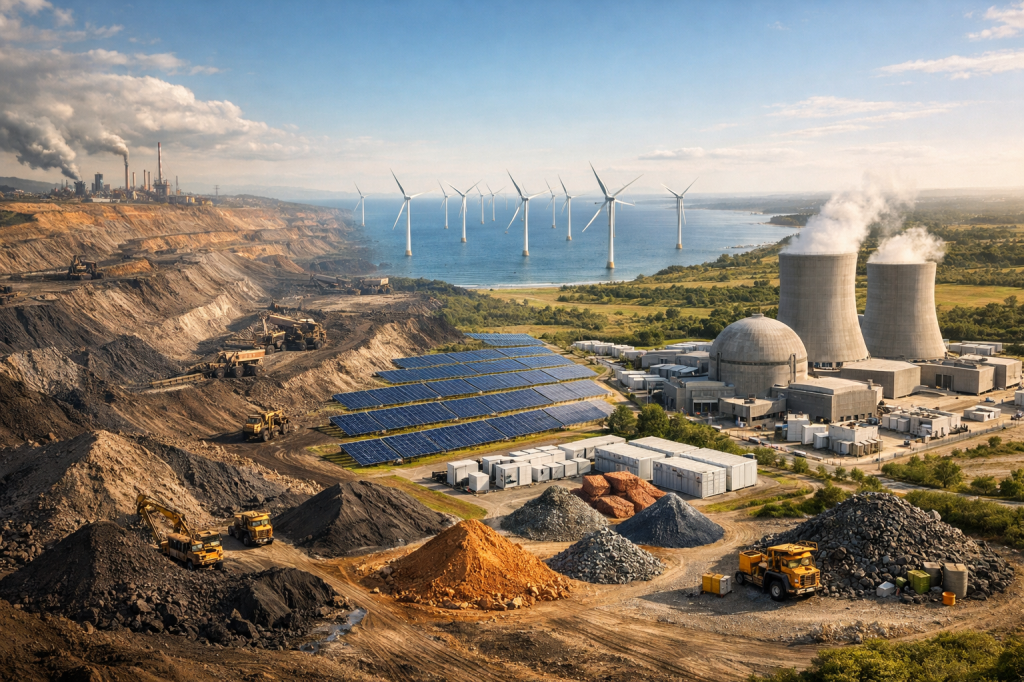
In the previous article there was a closing thought experiment section on ‘what if we stopped burning fossil fuels entirely’. The result was quite surprising. It was itself a follow up to an article on fossil fuel mining/extraction Vs. mining for renewables materials.
One critique of the analysis we provided argues that even if we stopped using fossil fuels for energy, we would still need to extract roughly the same quantity of oil because crude oil contains many useful products besides fuels. The implication is that petrol, diesel and jet fuel are unavoidable by-products of obtaining plastics, lubricants, pharmaceuticals, solvents, bitumen and other petrochemical products.
This argument sounds plausible, but it does not stand up well when examined in the context of the entire fossil fuel system.
We still need an oil industry
There is no realistic pathway to completely eliminating oil extraction in the foreseeable future, nor are environmentalists and those concerned with climate change advocating that. Society will continue to need:
- Plastics and resins
- Pharmaceuticals
- Synthetic fibres
- Solvents and industrial chemicals
- Lubricants and greases
- Bitumen and asphalt
- Certain specialist industrial feedstocks
However, these uses represent only a fraction of today’s oil consumption. The largest share of global oil demand still comes from fuels, particularly road transport, with aviation, shipping and other transport sectors consuming substantial additional volumes.
As transport electrifies, the International Energy Agency expects petrochemicals to become an increasingly important share of overall oil demand. Importantly, this is because fuel demand falls, not because petrochemical demand expands enough to replace it.
A reasonable estimate is that a future oil industry focused primarily on petrochemicals and specialist products could require roughly 70–90% less crude oil extraction than today.
Modern Refineries Are Not Simple Fractional Distillation Towers
The argument that “we must extract the same amount of oil because we need all the fractions” assumes refineries simply separate crude oil into fixed percentages of petrol, diesel and other products.
In reality, modern refineries:
- Catalytically crack heavy molecules into lighter ones.
- Reform hydrocarbons into higher-value chemical feedstocks.
- Hydrocrack middle and heavy fractions.
- Optimise output based on market demand.
Refineries are increasingly being designed to maximise chemical production rather than fuel production. If demand for transport fuels falls dramatically, refiners do not continue producing vast quantities of unwanted petrol and diesel. Instead, they process less crude oil and optimise more of each barrel towards useful products.
It’s not just about oil
Even if someone argues that oil extraction would not fall as much as expected, that argument applies only to oil.
It does not apply to most coal and natural gas extraction.
Coal is mined overwhelmingly to be burned.
Natural gas is extracted predominantly for electricity generation, heating and industrial energy.
Only a comparatively small proportion of either becomes chemical feedstocks.
The previous articles were concerned with abating fossil fuel use. Humanity uses a LOT of coal and gas and it would be possible, in an ideal world, to reduce the extraction of those by ~90% if we weren’t burning them.

What Happens Across All Fossil Fuels?
Using current global extraction levels as a baseline, a plausible future energy system dominated by renewables, storage and nuclear power might look something like this:
| Resource | Today | Future Non-Fuel Use | Reduction |
|---|---|---|---|
| Oil | ~5 billion tonnes/year | ~1 billion tonnes/year | ~80% |
| Coal | ~8 billion tonnes/year | ~0.5 billion tonnes/year | ~90–95% |
| Natural Gas | ~3 billion tonnes equivalent/year | ~0.5 billion tonnes equivalent/year | ~80–90% |
| Total | ~16 billion tonnes/year | ~2 billion tonnes/year | ~85–90% |
Note: These figures are estimates intended to illustrate scale rather than make precise forecasts.
The important conclusion is that even if substantial fossil extraction remains for petrochemicals and industrial feedstocks, the overwhelming majority of today’s extraction exists to supply energy. Replacing fossil-fuel energy with renewables and nuclear does not merely reduce emissions, it also reduces the total mass of material that humanity must extract from the Earth each year by a very large amount.
The Bottom Line
Critics often focus on the fact that we will still need plastics, chemicals and lubricants. That is true.
What is not true is the assumption that supplying those products requires maintaining today’s fossil fuel extraction industry.
The evidence suggests the opposite. A future economy powered largely by renewables, storage and nuclear would still require some fossil extraction for materials, but likely only a fraction of today’s level. Instead of extracting around 15–16 billion tonnes of coal, oil and gas every year and burning almost all of it, we could be extracting perhaps 1–3 billion tonnes, much of which would remain embedded in useful products rather than entering the atmosphere as greenhouse gases.
That distinction is crucial when comparing the long-term material footprint of fossil fuels with renewable and nuclear energy systems.

References
1.International Energy Agency (2025), Oil 2025: Analysis and Forecast to 2030.
www.iea.org
2.International Energy Agency (2026), Global Energy Review 2026 – Oil.
www.iea.org
3.International Energy Agency (2026), Sheltering From Oil Shocks – Road Transport Fuels. https://www.iea.org/reports/sheltering-from-oil-shocks/road-transport-fuels
4.Our World in Data (2024), Low-carbon technologies need far less mining than fossil fuels. Based on Wang et al. (2024).
https://ourworldindata.org/low-carbon-technologies-need-far-less-mining-fossil-fuels
5.MIT Climate Portal (2025), A New Approach Could Fractionate Crude Oil Using Much Less Energy.
climate.mit.edu
6.Mathew et al. (2022), Advances in Distillation: Significant Reductions in Energy Consumption and Carbon Dioxide Emissions for Crude Oil Separation, Joule.
www.cell.com
7.ICIS (2021), Petrochemicals to Capture More Than 50% of Crude Demand by 2050 – IEA. www.icis.com
https://iea.blob.core.windows.net/assets/018c3361-bc01-4482-a386-a5b2747ae82a/Oil2025.pdf

