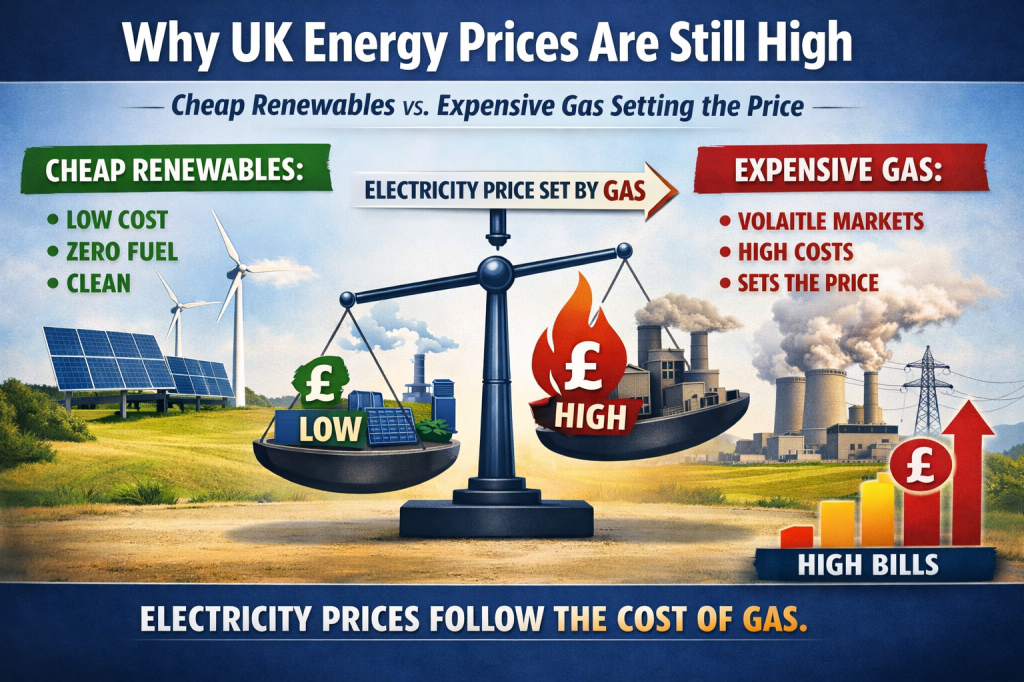
An explanation of why UK electricity prices are high for social media naysayers who keep asking without ever bothering to do an internet search or reading the comments.
Some questions get asked so often you start to suspect people don’t actually want the answer, having been given their opinion by a FUDwit, Oilbot or unethical media outlet or politician (I’m passed pretending otherwise).
This one is a classic, usually in response to headlines about the success of the UK wind and solar farms rollout:
“We’ve spent billions on solar farms and wind turbines, so why are our energy prices still the highest in the world?”
Let’s walk through the inconvenient facts. It’s not new, it’s been explained repeatedly by energy analysts, economists, and the UK government itself.
UK electricity prices are still set by gas
It’s really straightforward; the UK uses a marginal pricing system. That means the last power plant needed to meet demand sets the price. In the UK, that last plant is almost always a gas‑fired generator. Gas is expensive, and bad.
Carbon Brief explains this directly:
“The price of electricity is usually set by the price of gas‑fired power plants in the UK… This is due to the marginal pricing system used in most electricity markets globally.”
So even when wind and solar are producing huge amounts of power, the wholesale price is still pegged to gas. Even if 60% of power comes from cheap wind and solar at £30/ MWh, the final few percent frequently comes from gas.
So when gas costs £60–£70 per MWh it still sets the price for all electricity sold that hour.
This is the single biggest reason bills remain high.
When Russia invaded Ukraine prices spiked to £400–£450 per MWh, occasionally exceeding £500 per MWh during gas‑supply panic periods. That’s roughly a two‑to‑three‑fold increase in just a few weeks.
By mid‑2024, wholesale electricity averaged £70–£90 per MWh, much higher than pre‑2021 norms (markedly higher than the pre‑2021 norm, typically £30–£50 per MWh) . In 2025–2026, prices have hovered around £60–£80 per MWh, fluctuating with gas markets and wind output.
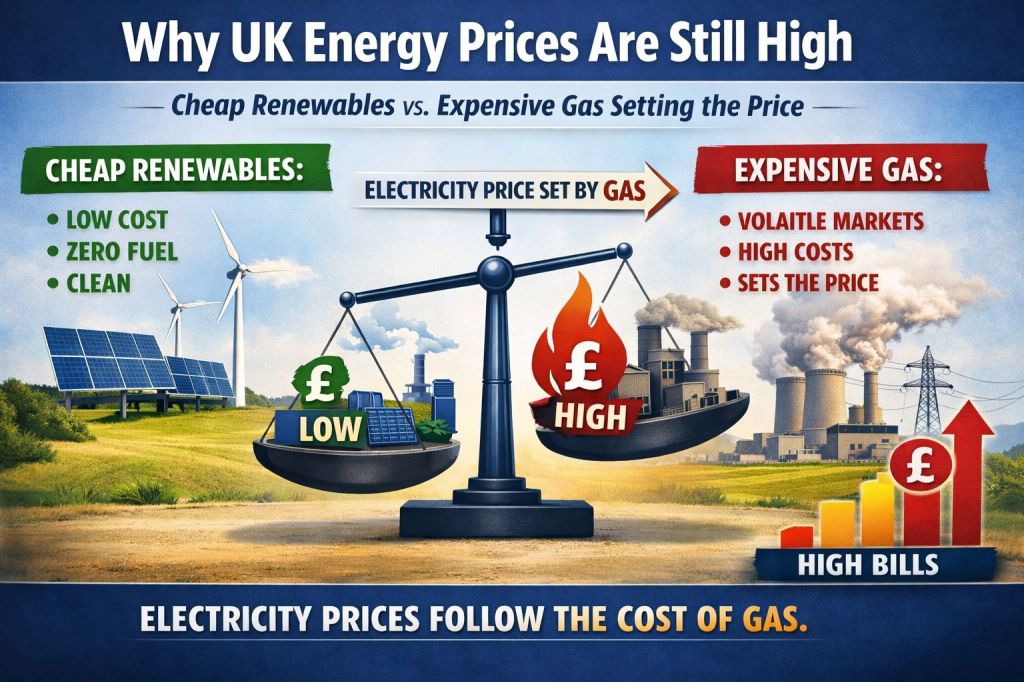
Renewables are already cutting prices significantly
Contrary to the social‑media myth, renewables are not driving prices up. They are doing the opposite.
The Energy & Climate Intelligence Unit (ECIU) quantified this in 2025:
Wind power reduced wholesale electricity prices by up to 25 percent in 2024
(around £24–25 per MWh).
Another analysis found that without wind, the average day‑ahead price of £73–76/MWh would have been £96–101/MWh.
A study, published in UCL Open Environment, found that between 2010 to 2023 wind-generated energy lowered electricity bills by £14.2bn and cut the cost of natural gas by £133.3bn. When offset by the £43.2bn in green subsidies consumers paid through their bills, the net result was a reduction of £104.3bn in UK energy bills over the 13-year period. Note this is energy bills, the biggest impact was on the price of gas due to reduced demand and the ability to buy it increasingly when the wholesale market price is lower. As a result gas prices have been highly resistant to the wholesale increases and this has benefitted domestic gas tariffs (which bear none of the cost of green subsidies) while having little effect on electricity prices (which carry all the cost of the subsidies). This irony is lost on most people, but is being assessed by the proposed energy market reforms.
In other words:
Renewables are already saving consumers money. Without them, energy bills would be dramatically higher.
This is not speculation. It is measured, published data.
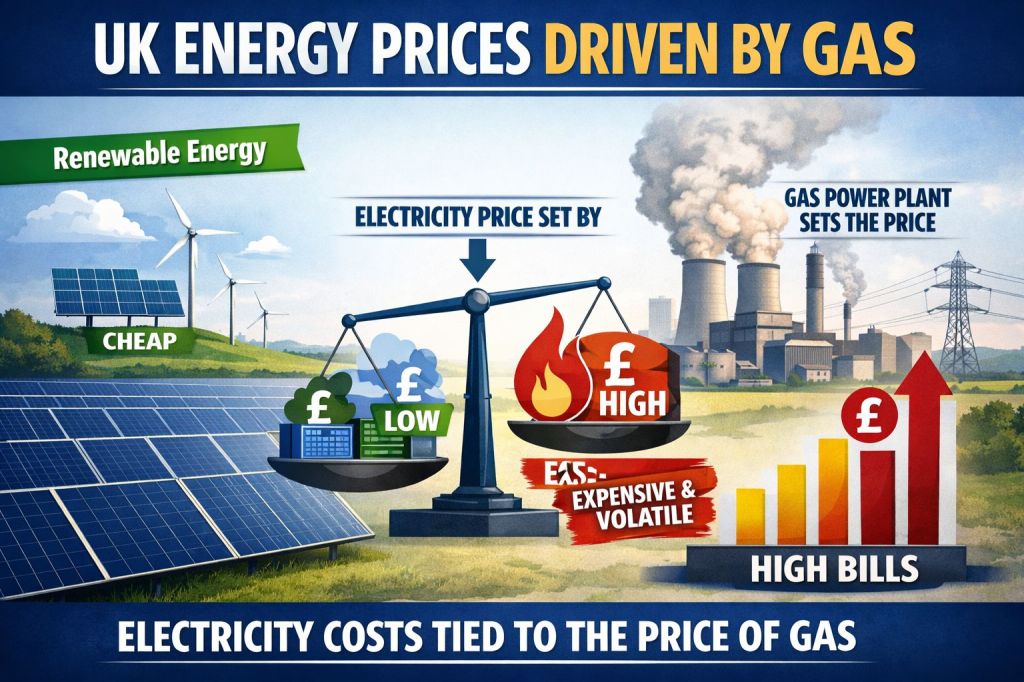
Because gas still dominates the price‑setting mechanism. When gas prices spike, electricity prices spike. This happened after Russia’s invasion of Ukraine in 2022, and again after the US–Israel strike on Iran in 2026.
So why do prices still feel high?
Even though renewables reduce the average price, the marginal price is still tied to gas most of the time.
ECIU notes that gas used to set the price almost 100% of the time. Renewables have pushed that down to around 85% but that still means gas is the dominant price‑setter, even though it only provides a third of our electricity in 2026.
Until gas stops being the marginal unit, bills will continue to reflect gas volatility.
Other structural reasons prices remain elevated
These are the real cost drivers that people rarely mention:
- Gas plants are paid to stay on standby
We do not yet have enough storage to balance the grid without gas. - We pay wind farms to switch off
Grid bottlenecks mean we sometimes cannot use the renewable power we generate. - Grid upgrades are slow and expensive
Years of underinvestment mean the grid needs major reinforcement. These costs land on bills. - Storage is still limited
Without large‑scale storage, gas remains essential for balancing. - The current funding model is unfair. By displacing gas use, renewables reduce its wholesale price. Electricity users pay 100% of the green subsidies, but receive only 18% of the financial benefit. Gas users, who pay nothing toward wind investment in their tariffs, receive 82% of the benefit through lower gas prices.
None of these problems are caused by renewables.
They are caused by the slow pace of grid reform and the legacy dependence on gas.
Do we really have “the most expensive energy in the world”?
No.
This is a common social‑media exaggeration.
UK electricity prices are high compared to some European countries, but they are nowhere near the highest globally.
According to Selectra’s comparison of UK vs EU household electricity prices:
The UK sits “near the upper end of European household prices”.
France is cheaper by about £91 per year for a typical 2,700 kWh household.
Eurostat‑based comparisons (via UK Government datasets) show that the UK is consistently above the EU15 average, but not the highest.
The following countries generally have higher household electricity prices than the UK:
Germany – high taxes and levies.
Denmark – historically among the highest due to taxation.
Belgium – high network and policy costs.
Ireland – high reliance on gas and limited interconnection.
Italy – high system charges and imported energy costs.
When will prices actually fall?
Prices fall meaningfully when three things happen:
- Market reform breaks the link between gas and electricity prices
The UK government has already announced steps to weaken this link, including encouraging older renewables to move to fixed‑price contracts. But analysts warn these changes are incremental rather than transformative. - More storage comes online
Storage reduces the need for gas to balance the grid. - Grid capacity expands
This stops the wasteful practice of paying wind farms to switch off.
As these three changes progress, the wholesale price will increasingly reflect the true low cost of renewables rather than the high cost of gas.
Summary
Renewables are not the reason your bills are high.
They are the reason your bills are not even higher.
The real problem is simple:
The UK still prices electricity based on gas. Gas is expensive and volatile.
Until that changes, bills stay high.
But the transition is underway.
As storage grows, grid upgrades accelerate, and market rules evolve, the UK will finally start to see the full price‑reducing effect of cheap renewable power.
Sources
UCL – Confirms gas set the UK electricity price 84% of the time.
https://www.ucl.ac.uk/news/2022/sep/electricity-prices-dictated-gas-producers-who-provide-less-half-uks-electricity
Energy UK –
Explains how marginal pricing works and why gas sets the clearing price.
https://www.energy-uk.org.uk/our-work/energy-explained/why-marginal-pricing-is-the-cheapest-way-to-run-our-electricity-market
Ofgem – Wholesale Market Indicators
Shows the 2021–2023 wholesale electricity and gas price spikes, including the surge after February 2022.
https://www.ofgem.gov.uk/energy-data-and-research/data-portal/wholesale-market-indicators
UK Government – Gas and electricity price statistics
Official datasets showing the 2022 price shock and subsequent decline.
https://www.gov.uk/government/collections/energy-prices-statistics (gov.uk in Bing)UCL – Analysis of renewable impact on pricing
Shows that renewable generation is cheap but does not set the marginal price.
https://www.ucl.ac.uk/news/2022/sep/electricity-prices-dictated-gas-producers-who-provide-less-half-uks-electricity
Energy UK – Marginal pricing explanation
Explains why renewables reduce average prices but not the marginal rate.
https://www.energy-uk.org.uk/our-work/energy-explained/why-marginal-pricing-is-the-cheapest-way-to-run-our-electricity-market
Ofgem – Breakdown of electricity bills
Shows wholesale costs, network charges, levies, and supplier hedging impacts.
https://www.ofgem.gov.uk/information-consumers/energy-advice-households/why-are-energy-prices-so-high
UK Government – International price comparisons
Confirms the UK is above the EU average but not the highest.
https://www.gov.uk/government/statistics/international-comparisons-of-energy-prices
UK Government – International comparisons of household electricity prices
Shows UK relative to Germany, Denmark, Belgium, Ireland, Italy, etc.
https://www.gov.uk/government/statistics/international-comparisons-of-energy-prices
UCL Open Environment – study on the effect of wind farms on domestic energy bills.
https://www.ucl.ac.uk/news/2025/oct/wind-power-delivers-ps104-billion-net-benefit-uk-consumers
EU‑wide comparison of household electricity prices.
https://ec.europa.eu/eurostat/statistics-explained/index.php?title=Electricity_price_statistics
IEA – Gas Market Report 2022–2024
Explains global gas volatility and its impact on European electricity prices.
https://www.iea.org/reports/gas-market-report-q3-2022
National Grid ESO – Electricity market reports
Shows how gas plants set the marginal price in GB’s wholesale market.
https://www.nationalgrideso.com/industry-information/market-reporting
 Sustainable Ferriby