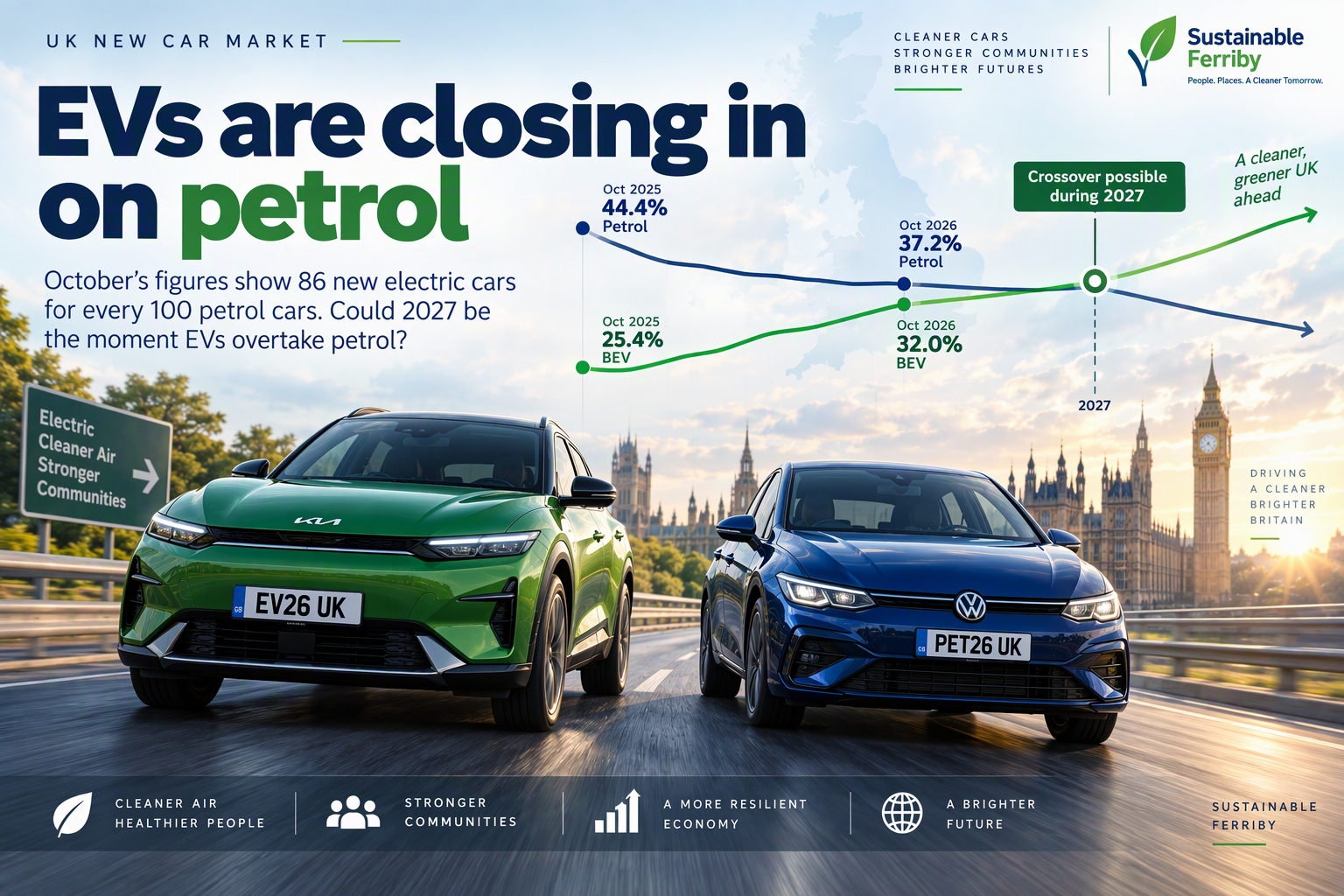
October’s UK new-car figures suggest we may be approaching a significant milestone in the transition to electric vehicles. For every 100 new petrol cars registered during the month, there were almost 86 battery-electric cars.
A couple of months ago, we suggested that monthly sales of new battery-electric vehicles (BEVs) could overtake petrol cars within a year. October’s figures strengthen that argument.
According to the Society of Motor Manufacturers and Traders (SMMT) October 2026 registration data, 48,858 new battery-electric cars were registered during October, compared with 56,876 petrol cars. BEVs therefore reached 85.9% of petrol registrations. 1

That’s getting remarkably close and it isn’t simply the result of a weak month for the car market. Total new-car registrations actually increased by 5.4% year on year, from 144,945 to 152,730.
Something more interesting is happening underneath that headline growth.
Petrol down, electric sharply up

The contrast between the two technologies is striking.
In October 2026:
- Petrol: 56,876 registrations, down 11.6% year on year.
- Battery electric: 48,858 registrations, up 32.7%.
- Diesel: 5,811 registrations, down 15.9%.
- Plug-in hybrid: 22,898 registrations, up 30.1%.
- Hybrid: 18,287 registrations, down 5.0%. 1
Consequently, BEVs accounted for 32.0% of all new cars registered in October, against 37.2% for petrol. A year earlier those figures had been 25.4% and 44.4% respectively.
In October 2025, petrol’s market share exceeded BEV by 19%. One year later, the difference was just 5.2%. It’s a substantial structural shift in only twelve months.
Think of it another way:
86 electric cars for every 100 petrol cars
Comparing absolute market shares can obscure just how close the two technologies have become. Divide October’s 48,858 BEV registrations by the 56,876 petrol registrations and the result is approximately 85.9%.
So for every 100 new petrol cars registered in Britain during October, there were approximately 86 new battery-electric cars.
The crossover point is 100.
From October’s position, BEV registrations would need to rise by only around 16.4% with petrol registrations unchanged. Alternatively, petrol could fall by about 14.1% with BEV registrations unchanged.
The more realistic scenario is likely to be some combination of the two. And that’s assuming linear growth/decline, while EVs are tending to show growth curves.
This is what makes October particularly interesting. BEV registrations aren’t merely increasing their share of a static market while petrol remains unchanged. The two are travelling in opposite directions.
BEV registrations increased 32.7% year on year, while petrol fell 11.6%. 1
The year-to-date numbers support that interpretation too. During the first ten months of 2026, Britain registered 503,805 BEVs, up 30.4% on the equivalent period in 2025. Petrol registrations, meanwhile, fell 4.4% to 778,492. In other words, BEVs’ year-to-date market share has risen from 22.4% to 26.6%, while petrol has dropped from 47.2% to 41.1%. It is an acceleration of a much broader shift.
When will electric overtake petrol?
Extrapolating car registrations is messy. Month-to-month figures are affected by the March and September registration-plate changes, fleet purchasing cycles, manufacturer incentives, model launches, supply constraints and plenty of other factors. We therefore shouldn’t claim that a particular month in 2027 will be the crossover. Equally, we no longer need an implausible EV growth scenario to produce one.
Using October as the starting point:
BEV = 48,858
Petrol = 56,876
The remaining gap is only 8,018 cars.
None of those requires anything remotely comparable with the 32.7% year-on-year BEV growth recorded in October. While that doesn’t prove that the crossover will happen in the next few months, it does demonstrate why a crossover during 2027 is now entirely likely if the underlying trend continues, and possibly by mid-year if the trends hold.
Of course, we could quite reasonably see an individual month in which BEV registrations exceed petrol, followed by another month in which petrol moves back ahead. Seasonal effects alone could produce that. The more significant milestone would come later: when BEVs consistently outsell petrol over sustained periods and eventually over a complete calendar year. I suspect that will be in 2028.
The change is bigger than BEVs alone
There’s another revealing way to look at October.
Petrol and diesel together represented 41.0% of the new-car market.
BEV, plug-in hybrid and hybrid vehicles together represented 59.0%. 1
That doesn’t mean 59% of new cars were zero-emission. Clearly they weren’t: hybrids still contain combustion engines, and lots of people don’t even plug those in (making them very expensive and polluting to own), but it does illustrate how far the market has already moved away from the traditional petrol-or-diesel choice.
Diesel’s decline is especially remarkable. Its October market share was just 3.8%. For anyone who remembers diesel dominating UK company-car choices not very long ago, that’s quite a transformation.
Consumers are being offered far more choice
One thing sometimes missing from discussion about EV adoption is how much the market itself has changed. Electric cars aren’t an experimental sideshow any longer. Buyers can now choose across an increasingly broad range of vehicle types, sizes and price points.
The SMMT data show, for example, substantial growth among manufacturers including BYD, MG and several newer entrants alongside the established European, Japanese and Korean brands. That matters because greater competition tends to produce more models, better specifications and increasing pressure on prices. 1
For consumers, the transition increasingly becomes less about whether an electric car can do the job and more about which electric car best does the job.
That is a rather different market from the one Britain had even three or four years ago.
A caveat
New registrations are not the same thing as Britain’s installed vehicle fleet.
There are millions of existing petrol and diesel vehicles on UK roads, and cars typically remain in service for many years. Even after BEVs become the largest category of new registrations, replacing the existing combustion-engine fleet will take considerably longer.
Nor does rapidly increasing EV adoption make the remaining problems disappear. For example, to keep up with the growth of EVs, Britain still needs continued investment in public charging, convenient charging for people without driveways, electricity network capacity and affordable vehicles.
But none of those qualifications changes what the registration figures are telling us.
The direction of travel is increasingly clear.
End note
A few years ago, the question was:
Will electric cars become mainstream?
The market has already answered that. The more interesting question now is:
When does electric become the single largest powertrain in the UK new-car market?
October 2026 brought us surprisingly close. BEVs grew 32.7% year on year. Petrol fell 11.6%.
No heroic growth assumption is now required to close the remaining gap.
So we’ll stick with the prediction made a couple of months ago, albeit with the appropriate caveat:
If the present direction of travel continues, we could see the first month in which BEVs outsell petrol cars during 2027, potentially by the middle of the year.
Monthly data are noisy, but after October’s figures, the crossover is no longer some distant theoretical milestone.
If you are thinking of changing cars any time soon you should test drive an EV. They are pretty much better in every respect.

Sources
Figures are from the Society of Motor Manufacturers and Traders (SMMT) UK car registration data. 1