A Small Change That Could Make a Big Difference
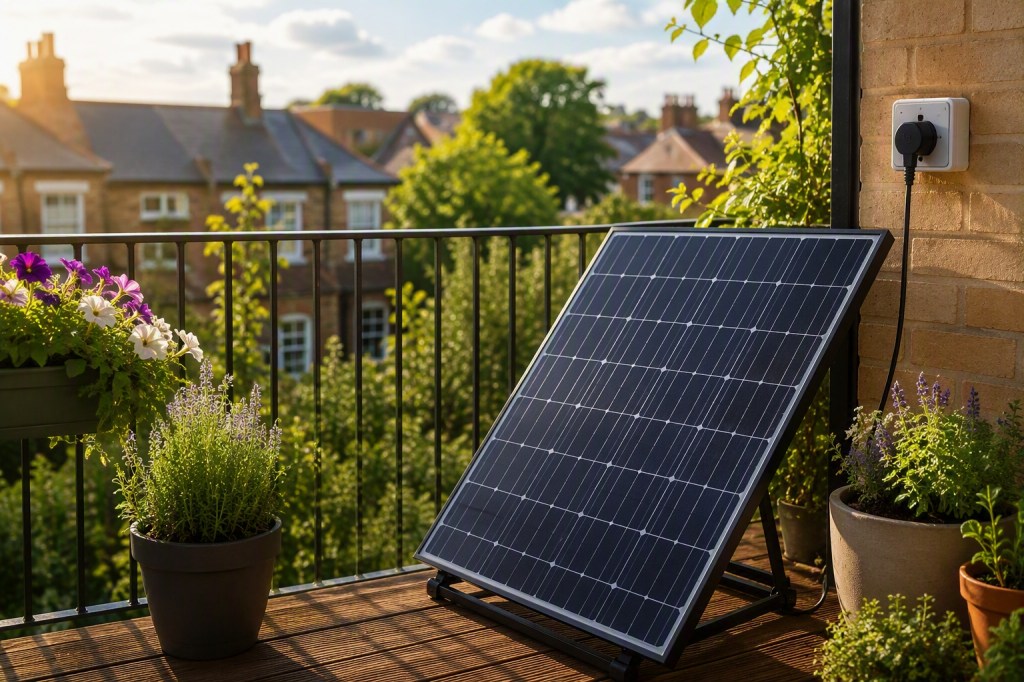
27 August 2026 marked an important milestone for home energy in the UK. Compliant plug-in solar systems are now legal across Great Britain, allowing households to generate electricity simply by plugging an approved solar kit into a standard socket. For many people, particularly those in flats, rented homes, or properties unsuitable for rooftop solar, this is the first realistic opportunity to generate their own renewable electricity.
Plug-in solar is not just for homeowners. Flats, rented properties and community buildings now have options that simply didn’t exist before.
Unlike traditional rooftop solar, plug-in systems are designed to be simple. A typical kit consists of one or two solar panels connected to a micro-inverter, producing up to 800W of AC power. The new regulations allow certified systems to be connected directly to a household socket without the need for an electrician, provided all safety requirements are met. Only approved, certified kits qualify, and there is currently a limit of one device per household. Note that people need to notify their grid operator (DNO) within 28 days of installing a plug-in solar system, so the network operators know how much power is flowing around, and how demand might change. Currently you can do this easily on this website https://myplugin.solar/
What Can You Save?
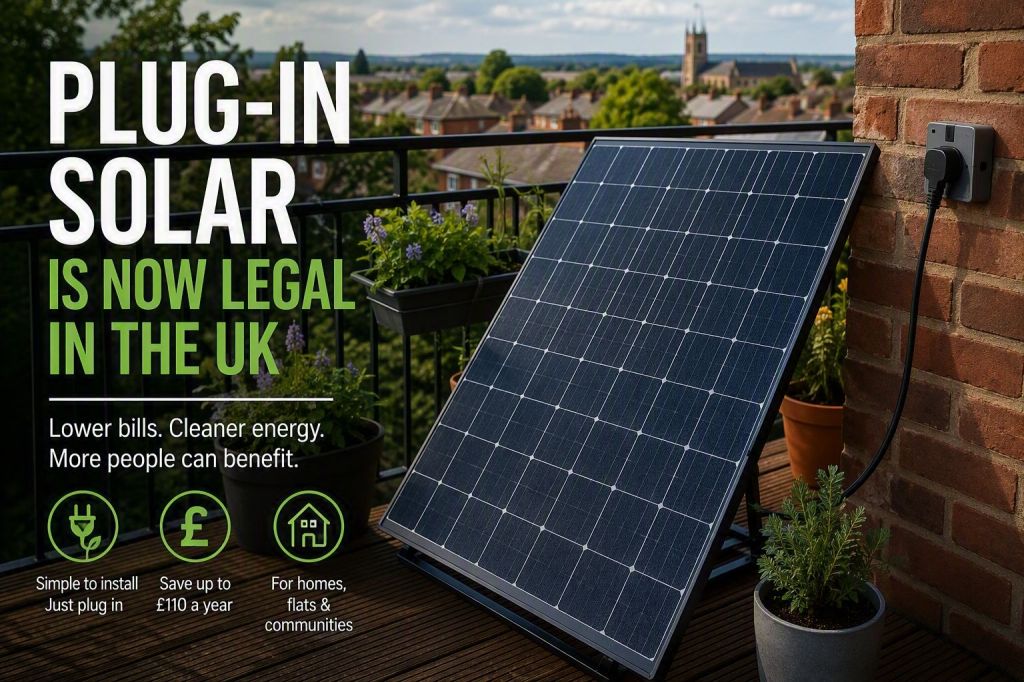
The Government estimates that an 800W system could provide up to 20% of an average home’s electricity use and save up to £110 per year. Actual savings depend heavily on how much electricity you use during daylight hours. Homes occupied during the day, or those with continuously running appliances such as fridges, broadband routers, home offices, aquariums or heat pumps, are likely to see the greatest benefit. It’s also worth noting that 800W is the maximum hte panels are allowed to export, so it’s possible some will be 1000W or even more as actual output will be less unless they are angles to the sun correctly.
Current retail pricing suggests entry-level systems start at around £599, with larger systems costing more. At the lower end of the market, a £599 system saving £80 to £110 annually would have a simple payback period of roughly five to eight years. Given that solar panels typically last 25 years or more, the lifetime return could be substantial.
For many households, however, the attraction is not purely financial. Plug-in solar offers a low-cost entry point into renewable energy without scaffolding, roof work, planning complications or significant upfront expense.
Who Benefits Most?
These systems are particularly attractive for people living in flats with balconies, households with suitable garden space or south-facing walls, renters who cannot install conventional rooftop solar. Home workers or anyone who can consume more the generated electricity during daylight hours when it’s being produced will achieve the greatest savings.
Germany’s experience demonstrates the potential. Millions of Europeans have already adopted similar “balcony solar” systems, creating a mature market that has helped shape the UK’s new regulatory framework.
The Risks and Limitations
Plug-in solar is not a miracle solution and there are some important caveats.
The maximum permitted output is 800W, meaning these systems will only cover a fraction of the energy needs of most households. Government estimates suggest around 20% of an average home’s electricity consumption under favourable conditions.
Batteries are currently excluded from the new plug-in framework. Energy generated during sunny periods needs to be used at the time it is produced, otherwise some of it may be exported to the grid without financial reward. However, batteries are probalby coming (and there’s little to stop people who know what they are doing to use a battery, though at their own risk).
Consumers should also note that only approved products may be used, extension leads and adaptors are prohibited, mounting systems must be robust enough to withstand adverse weather, and leasehold or planning restrictions may still apply depending on the installation location.
What About Export Payments?
One of the biggest opportunities is being paid for exporting uneused electricity. At this point export is allowed, but you will not be paid for it.
The good news is that progress is being made. Both Octopus Energy and Fuse Energy have publicly indicated that they are working on mechanisms to allow plug-in solar users to access export payments. According to recent reporting, Octopus intends to make its existing Outgoing Octopus tariff, currently paying 12p/kWh, available once registration arrangements are clarified. Fuse Energy has also confirmed it is developing an export solution, although details have not yet been announced.We do know it pays its existing customers 13p/kWh however.
For most households, however, export income is likely to remain secondary. The greatest value still comes from using the electricity yourself and avoiding importing power from the grid.
The Bigger Picture
Plug-in solar is unlikely to replace conventional rooftop solar. What it does offer is something arguably more important: accessibility. For hundreds of thousands of households previously excluded from home generation, it provides a low-cost, low-risk way to participate in the energy transition and reduce household bills.
It is also a reminder that reducing energy costs rarely depends on a single measure. Plug-in solar can make a useful contribution, but households should also look at improving insulation, switching to LED lighting, reducing standby consumption and optimising heating controls.
Flick the switch
Energy tariffs matter too. At the time of writing, one of the simplest, no cost opportunities for many households may be switching gas supplier. Fuse Energy, for example, currently offers one of the lowest gas standing charges around, combined with a very competitive rate per kWh if gas used. For homes with relatively modest gas usage, standing charges can account for a significant proportion of annual costs. In many cases switching will save £50 per year on the standing charge. Even better, there is often a switching credit, worth as much again (or more)
If you do switch before 18 Sep and use referral code SIMON82967 you’ll receive £100 and Sustainable Ferriby CIC will benefit too https://www.fuseenergy.com/app
Combining a competitive tariff with sensible energy efficiency measures and a plug-in solar system could reduce household energy bills by considerably more than any single intervention on its own.
Win:Win:Win
The arrival of plug-in solar may not transform Britain’s energy system overnight, but it removes a barrier that has excluded many households from generating their own clean electricity. For a relatively modest investment, it offers a practical first step towards greater energy independence, lower bills and lower carbon emissions.
Sources:
- UK plug-in solar regulations: https://camerajabber.com/photography-news/plug-in-solar-is-now-legal-in-the-uk-what-studios-need-to-know/
- Where to buy: https://www.independent.co.uk/extras/indybest/house-garden/where-to-buy-plug-in-solar-panels-uk-b3040171.html
- Planning rules: https://www.planninggeek.co.uk/2026/plug-in-solar-planning-permission-new-rules/
- Launch-day UK retail pricing from approved products: https://www.independent.co.uk/extras/indybest/house-garden/where-to-buy-plug-in-solar-panels-uk-b3040171.html
- Octopus Energy and Fuse Energy export tariff developments: https://www.pluginsolarexplained.co.uk/blog/octopus-fuse-plug-in-solar-export-tariffs/ https://octopus.energy/export-tariffs/

