
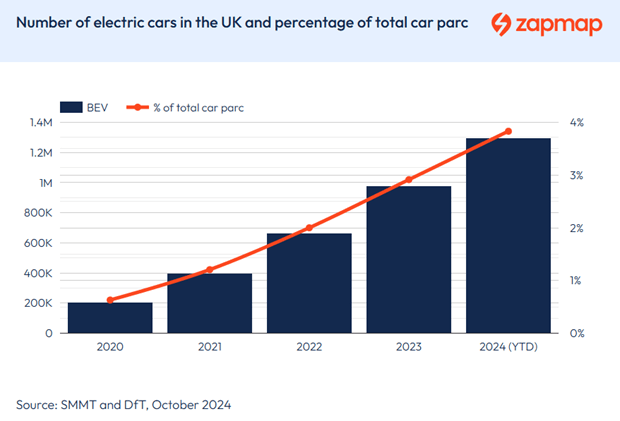
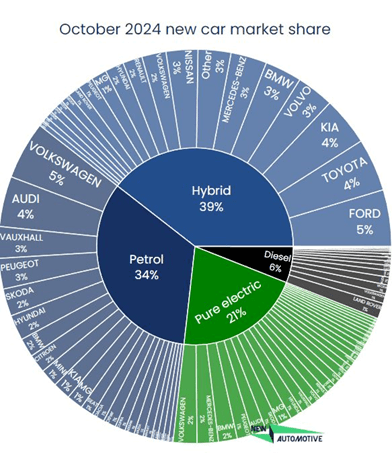
The transition to electric vehicles (EVs) is a critical component of the UK’s strategy to reduce carbon emissions and combat climate change. In almost every respect, EVs have equalled or surpassed internal combustion engine vehicles (ICEs) and EV sales continue to climb. Battery Electric Vehicles are expected to be ~20% of new car sales in 2024. As of the end of October 2024, there are just under 1,300,000 fully electric cars in the UK; about 3.8% of the 34 million cars on UK roads are now fully electric. There is an excellent analysis of the EV market share in the UK here.
Significant barriers to reaching 100% EV adoption remain. Many are due to fear of change, uncertainty of how to benefit from the EV transition and some doubt about how good EVs already are; these are relatively easy to address. A more embedded issue is the availability of off-street parking in order for owners to use their own charging infrastructure.
This article provides an insight into the proportion of households with and without off-street parking across different regions in the UK, examines the demographics of homes lacking such parking, and explores the potential solutions for EV charging in these scenarios.
EV’s can’t work because no one has off street parking
Proportion of Households with and without Off-Street Parking
According to 2021 data1 , of the UK’s 27 million households approximately 35% of UK households do not have access to off-street parking. That’s about 9 million homes.
Approximately 77% of households own at least one car, about 20 million households.
This proportion varies significantly by region, with urban areas being particularly affected.
| Region | With Off-Street Parking (%) | Without Off-Street Parking (%) |
| England | 68% | 32% |
| London | 30% | 70% |
| South East | 60% | 40% |
| North West | 55% | 45% |
| Scotland | 50% | 50% |
| Wales | 65% | 35% |
However, the data2 also reveals that car ownership is lower and public transport provision is much higher in urban areas.
- Urban Areas: Approximately 33% of households in urban conurbations do not have a car.
- Non-Urban Areas: Only about 5% of households in rural villages, hamlets, and isolated dwellings do not have a car.
Homes without off-street parking are predominantly found in densely populated urban areas. These homes are often older properties, such as Victorian and Edwardian terraces, and are more likely to be rented rather than owned. It’s reasonable to infer that a large proportion of homes in London and other major cities that lack their own parking also don’t have a car. Nevertheless, it is true to say that somewhere around 7 million households that own a car don’t have an option for off street parking and therefore can’t benefit from home charging an EV when they buy one.
There is a more detailed breakdown by local authority here:
The Daily Commute
It’s important to understand how far most people travel per day3 based on the two styles of living.
- Urban Areas: People living in urban conurbations drive an average of 3,661 miles per person per year, which breaks down to about 10 miles per day. To put that into perspective, that’s less than 3 minutes charge time on a mid-speed (50kW) charger, or an hour plugged into an ordinary household socket using a granny charger.
- Non-Urban Areas: People living in rural villages, hamlets, and isolated dwellings drive an average of 6,449 miles per person per year, which is approximately 18 miles per day.
Homes with Off-Street Parking
For homes with off-street parking, enabling EV charging is relatively straightforward.
- Most homeowners install a dedicated EV charger. Domestic 7kW chargers start at £400 rising to £650 for sophisticated smart charger like the MyEnergi Zappi, plus installation (around £500). Many EV manufacturers offer chargers with the sale of a new EV. Government grants can be available e.g., for landlords or live in a flat. For reasonably efficient EVs these add 25-30 miles of range per hour (300+ miles overnight). Ideally, people should use this as an opportunity to declutter their garage and install a charger there, where it’s dry and a little warmer. However home chargers are designed to be weatherproof, so expect to see more and more adjacent to people’s driveway.
- For people who rarely need to charge their car from empty to full plugging into an ordinary 3 pin socket at home can be enough. This uses a so-called ‘Granny charger’, often included with new EVs or about £100 if you have to buy one. They are portable, so are also a good solution if you need to plug in at a friend’s house or a B&B (with their permission, of course). These add 10-12 miles of range per hour (110-150 miles overnight). Your home’s electrics need to be in good condition and regulations now say that a dedicated spur is required for extended use.
Most charging takes place while EV owners are doing other things such as shopping, working, grabbing a coffee of sleeping
These options are summarised in the table below. This will also be useful when reading the rest of the article to understand that most charging takes place while EV owners are doing other things such as shopping, working, grabbing a coffee of sleeping.
| Charging Speed | Power Output (kW) | Time to Charge 10 Miles | Time to Charge 18 Miles |
| Slow Charger | 3 kW | ~1 hour 45 minutes | ~3 hours |
| ‘Fast’ Charger | 7 kW | ~45 minutes | ~1 hour 20 minutes |
| ‘Rapid’ Charger | 22 kW | ~15 minutes | ~27 minutes |
| ‘Ultra-Rapid’ Charger | 50 kW | ~6 minutes | ~11 minutes |
| Motorway ‘Super charger’ | 150kW+ | ~2 minutes | ~4 minutes |
Thinking about it on a weekly basis, an urban family doing 70 miles per week only needs to plug in for an evening once per week and even for those doing the higher number of miles a single overnight charge each week is enough.
An urban family doing 70 miles per week only needs to plug in for an evening once per week
Comparison with ICE fuelling
To put this in perspective, the actual time people spend fuelling legacy vehicles in the real world is as follows:
Estimated Time Spent at the Forecourt
- Arrival and Parking: On average, it takes about 2-3 minutes for a car to find a parking spot and pull up to the pump.
- Fuelling Time: The actual time to dispense fuel is typically around 3-5 minutes for petrol and 4-6 minutes for diesel.
- Payment and Departure: Payment and any additional time spent at the pump can take about 2-3 minutes.
Total Estimated Time
Adding these together, the total estimated time spent at the forecourt for petrol cars is approximately 7-11 minutes, and for diesel cars, it’s around 8-13 minutes.
For a family filling their car every other week that adds up to around 5 hours per year.
Alternatives to EV charging from a home charger
There are several alternatives for EV charging to accommodate households without off-street parking:
Public Charging Stations
There are currently at least as many public chargers as there are petrol pumps.
As of January 2024, there were 53,6774 public electric vehicle (EV) charging devices installed across the UK. This includes a mix of slow, fast, rapid, and ultra-rapid chargers. That had increased to 71,4595 as of October 2024, spread across 36,060 charging locations and include 108,633 connectors. There are currently at least as many public chargers as there are petrol pumps.
On-Street Charging
Installation of lamppost chargers and dedicated on-street charging points directly outside homes is a useful solution for the very many urban streets, and lower proportion of non-urban roads where people don’t have driveways etc. Many local councils work with charge point operators to install on-street chargers. Companies like Connected Kerb and char.gy are key players in this space.
The most common types are:
- Lamp-Post Chargers: These are chargers integrated into existing streetlamps. They are cost-effective and don’t require extensive civil work.
- Bollard Chargers: These are standalone units installed on the roadside or in car parks.
- Pop-Up Chargers: These chargers rise from the ground when summoned by a smartphone app.
- Metal Channels: These are dug into pavements to enable running a cable from a charge point on a nearby wall or from a home to the kerbside.
The cost of using on-street chargers can vary depending on the operator and location. For those not connected directly to homes, charges range from £1 to £2 per hour, so 15p/kWh to 28p/kWh for slow chargers (3kW – 7kW). Some operators may offer subscription models or membership plans for reduced rates.
The overall number of kerbside chargers remains low but are increasing as councils respond to the demand and government strategy.
| Type | Estimated Number |
| Metal Channels | 1,200 |
| Pop-Up Chargers | 800 |
| Lamp-Post Chargers | 5000 |
| Bollard Chargers | 800 |
This ignores the much larger number of fast chargers. These are not intended for overnight, domestic charging, but do provide ample options for quick charging for car owners, predominantly in urban areas. In addition to the 5,300 ‘domestic’ chargers (under 7kW) there are a further 18,600 rapid street side chargers (greater than 7kW).
Workplace charging
According to data from Fleetworld6, over half of all workplaces offer charging. This is increasing as more companies recognise the importance of supporting electric vehicle adoption among their employees and employees take advantage of EV purchase schemes through their work. In fact, of those who don’t currently offer charging at business premises, 88% of respondents said they “definitely” or “probably” will install them in the next three years. This is in addition to government charging requirements that came into force in England as of June 2022 and require new homes, and buildings such as supermarkets and workplaces to install charge points.
According to Fleetworld, over half of all workplaces offer charging
Co-charging
Charger sharing platforms, like Co Charger, JustCharge and Joosup, enable people with home EV chargers to lend them or rent them out to neighbours / other owners who need to charge their electric vehicles. This is a terrific way for people to conveniently get their weekly charge at a reasonable cost.
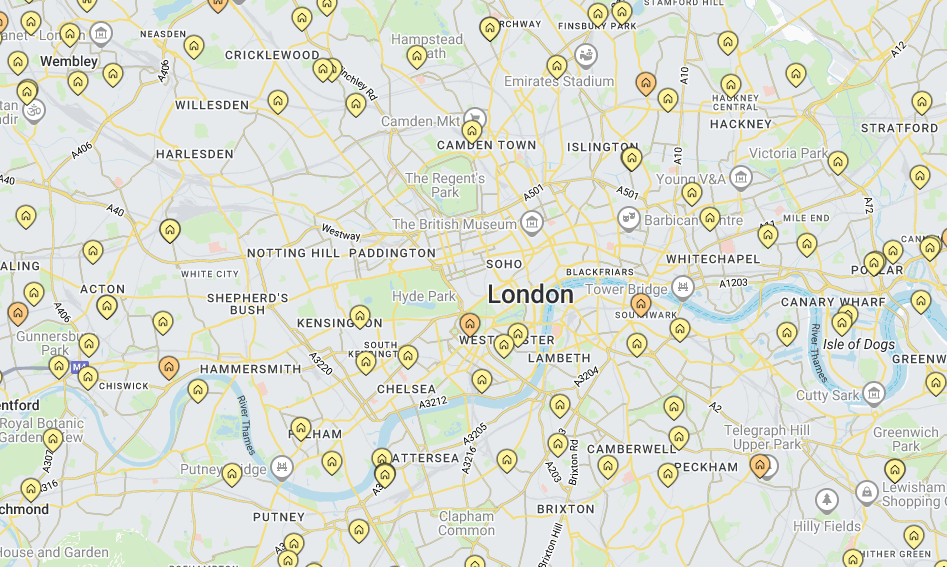
With co-charging, people with off street parking and home chargers can sign up as hosts on the co-charging platforms. Those needing to charge their EVs can find and book available chargers through the platform app, or via ZapMap. Informal arrangements also exist. ZapMap data indicates around 9,200 shared home charge points, adding to the other public chargers.
Conclusion
The disparity in access to off-street parking across the UK poses challenges for the adoption of EVs. While homes with off-street parking can easily transition to EVs by installing home chargers, innovative solutions are necessary to support those without such facilities. The expansion of public charging infrastructure, on-street charging solutions, and community hubs are essential to ensure equitable access to EV charging and to promote the widespread adoption of electric vehicles.
There are already 150 thousand EV charge points.
Adding up the 9,200 shared home chargers, 108,000 public charger connectors and 33,000 workplace chargers there are already 150 thousand places for EV owners to charge. Simplistically, if every person without off street charging were to suddenly buy an EV there would be 1 charger for every 60 of these ‘can’t charge at home’ cars. Again simplistically, so ignoring peaks and troughs, the total charger utilisation would be less than 30%. It’s a silly number but does illustrate that the success of the EV transition will not be constrained by those folk who can’t have a home charger. By the time the late adopters of these great vehicles choose to transition the infrastructure will have long since stopped being a reason to hold off.
References
- https://www.racfoundation.org/motoring-faqs/mobility
- https://www.gov.uk/government/statistics/national-travel-survey-2021/national-travel-survey-2021-travel-by-region-and-rural-and-urban-classification-of-residence.
- https://www.gov.uk/government/collections/national-travel-survey-statistics
- https://www.gov.uk/government/statistics/electric-vehicle-charging-device-statistics-january-2024/electric-vehicle-public-charging-infrastructure-statistics-january-2024
- https://www.zap-map.com/ev-stats/how-many-charging-points [1] https://fleetworld.co.uk/over-half-of-workplaces-provide-charging-facilities-finds-europcar-study/
 Sustainable Ferriby
5 responses to “Off-street EV charging options”
The proportion of people unable to charge at home would slashed, if the law was charged so that if a house has an EV charging point then the space in front of the house was a reserved parking space for the occupant’s EV.
For the occupants of terraced houses, this would provide a positive incentive to owe an EV as it would allow them to reserve the space in front of their house, which I know a great many such persons would love to be able to do.
We should campaigning for such a law.
LikeLiked by 1 person
That’s a good idea. I’d vote for it if you start a petition.
LikeLike
The article talks about “metal channels” to take cables across the pavement, but roughly 90% of installed cross-pavement channels in the UK are in fact polymer construction like http://www.kerbocharge.com so that it can bend to match the cambered and uneven surfaces of pavements, which are rarely flat and straight.
LikeLike
That’s interesting and makes excellent sense. Thanks for the update.
LikeLike
[…] Also see the article on off street parking challenges: […]
LikeLike