
Many people consider modern solar panels to be rather attractive, both for their modern, clean look and for what they represent. Those people who ignore the façade of a building while extolling the virtues of the predictable tessellation and style choice of the tiles, slates and other coverings on British roofs are thankfully rare 😊. However, some people do care about the visual appearance of their roof and do not subscribe to the ‘solar panels look great’ position. There is also the reasonable question of what to do with heritage buildings in conservation areas or those which are listed buildings.
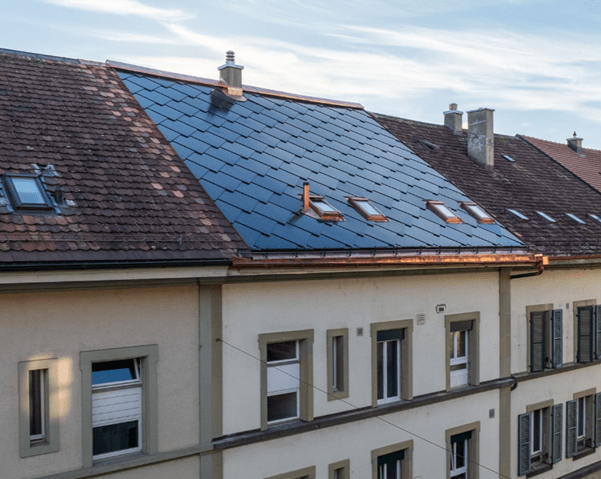
The first alternative is to use in-roof panels. While these are undoubtedly neater, they are still rather large (1.7 m x 1.1 m) panels and don’t offer a traditional appearance. On the other hand, solar tiles are potentially a great alternative to in-roof panels. Some promise to retain the traditional roof style, the smaller tiles often fit better around dormers and skylights, chimneys and complex roof shapes, while products like the Sunstyle ‘dragon-scale’ solar roof tiles look fantastic and make a roof statement worth admiring.
Sadly, unlike on-roof panel products, of which there are hundreds of models and dozens of major suppliers, in-roof and solar tiles offer a rather more limited range of choices, with only a handful of each. They also tend to be higher cost and lower output than the cutting edge and economy of scale on-roof systems. This article takes a deeper look.
In-Roof Solar Panels
The following list may not be exhaustive,m but represents the main in-rood options in the UK.
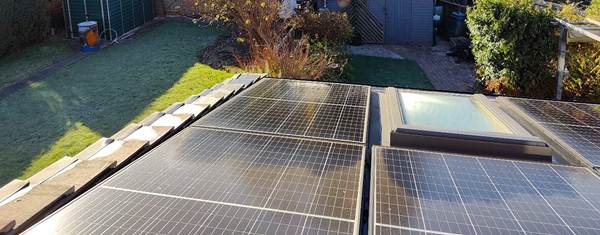
- Viridian Solar
Clearline Fusion Range
A long‐standing supplier in the UK, known for its integrated cassette systems that allow flush installation and reliable performance.
- GSE Integration
Specializes in French‐designed in‐roof mounting trays. Their systems allow standard PV modules to be integrated seamlessly into new or retrofit roofs. - Easy Roof Evolution
Offers a modular mounting system engineered specifically for flush in‐roof panel installations. This solution is popular in projects where aesthetics and performance are both priorities. - Solfit Innovative In‐Roof Panels
A UK‐based company dedicated to in‐roof technology. Their patented interlocking design delivers a truly integrated look with minimized components, ensuring ease of installation and a watertight finish. - Burton Roofing Merchants
Through their “Sandtoft In‐Roof Solar Panel” product, they offer a solution that installs directly onto the roof battens without the need for additional trays or clamps. This product is designed to create a seamless modern roof that retains the traditional aesthetic while generating PV power. - Marley SolarTile® – Monocrystalline glass-glass modules that sit in laths like a tile, but are really in-roof panels in our opinion. Good though
Solar Tiles
There are fewer solar tile options, but more than a few years ago and many look fantastic.
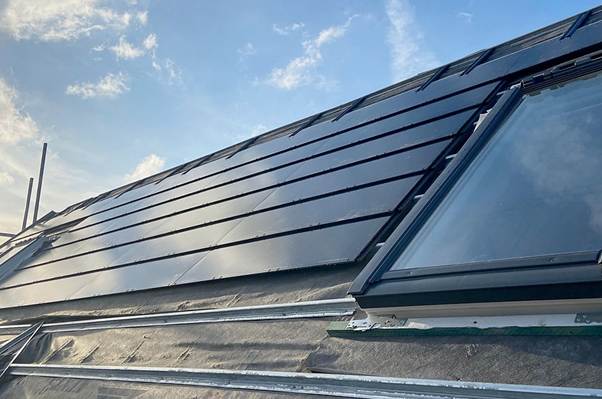
- GB-Sol PV Slate – Welsh-made solar slates designed to blend with traditional slate roofs
- SunStyle – Dragon-scale glass solar shingles (distributed via Enera/Trinergy)
- Marley SolarTile® – Monocrystalline glass-glass modules that sit in laths like a tile
- Nulok Solar Inserts – Rectangular glass-glass PV inserts specifically for Nulok roof systems.
- Ergosun Solar Tiles – Integrated solar tiles with a discreet appearance
- Tesla Solar Roof – Tempered-glass solar tiles with integrated PV; despite some advertising this system is not available in the UK
The following is a comparison of in roof and tile systems, indicating pricing and efficiency. All the systems offer a 25+ year warranty or better. For comparison, on-roof panels typically are 22-24% efficient and offer outputs between 180 and 220 watts per square metre.
| Supplier Product line | Tile power; Output per m2; Efficiency | Typical retail price* | Typical fully–installed price* |
| Marley SolarTile® In-roof monocrystalline glass-glass panels that sit in laths like a tile | 335 W; 206 W/m²; 20.7% | £265–310 m² | £1,800–2,100 / kWp on new-build; £2,200–2,600 / kWp on retrofit |
| Viridian Clearline® Fusion In-roof panels | 335 W; 197 W/m² 19 % | £240–280 m² | £2,400–3,000 / kWp |
| GB-Sol “Solar Slate” & “Solar Slate Plate” tiles (hand-made Welsh slate look-alikes) | 28 W; 224 W/m²; 15% | £290–330 m² | £3,800–5,200 / kWp (high labour, heritage roofing) |
| SunStyle (via Enera/ Trinergy) Dragon-scale glass tile shingles | 115 W; 169 W/m²; 17 % | £270–320 m² | £2,800–3,500 / kWp |
| Nulok Nulok Solar ‘tile’ Inserts (rectangular glass-glass inserts for Nulok roof system) | 140 W; 179 W/m² 18 % | £250 m² + £110 m² Nulok rails | £2,500–3,200 / kWp (if whole roof done in Nulok) |
* Ex-VAT real-world quotes from UK installers Jan–May 2025. Prices exclude scaffolding; installation tends to be higher with retrofit due to need to remove existing tiles and ‘fettle’ the existing roof. There may be additional costs for trays or other fittings.
Comparing tiles with in-roof panels
Tiles are now fairly comparable with in-roof panels. They tend to be a little more expensive and have potentially lower output, through it’s often possible to get a greater coverage on complex roofs or where the roof isn’t optimal for the standard panel sizes.
| Solar roof tiles | Standard in-roof panels | |
| Module efficiency | 15-20 % | 19-23 % (full-size modules) |
| Cost per kWp (retrofit) | £2,200–5,000 kWp | £1,300–1,800 kWp |
| Cost premium over on-roof panels | 2 – 4 times | 1.2 – 1.5 times |
| Watertightness risk | Each tile → more joints to flash; good roofers essential | Fewer large trays; simpler |
| Weight | Similar or lighter than concrete tiles (11–18 kg m²) | Slightly heavier than tiles |
| Maintenance | Individual tile swap possible but slow | Whole cassette swap in minutes |
| Aesthetics & planning | Looks like slate/clay; popular in conservation areas | Still visibly “panel” |
| Decommissioning | Many small tiles; labour-heavy | Palletise modules easily |
| Resale value | Highest if roof age ≤ 3 yr and aesthetic is priority | Value comes mainly from generation not looks |
Disadvantages of tiles vs. in-roof PV
- Price/kWp. Tiles typically double or treble project cost because you pay for roof and PV in one item. The tile market is still niche so economies of scale lag behind module prices that fell 30 % in 2023 alone.
- Lower yield per square-metre. Inter-tile gaps and smaller cells can push overall efficiency down ~1-3 %; a south-facing 30 m² roof gives ~4.5 kWp with panels but only ~3 kWp with slates.
- Vendor risk. Several tile pioneers (Solarcentury SunSlates, PV Systems PV-Slate) exited the market, leaving owners hunting eBay for spares. Stick to brands with UK stock and long histories.
- Certification gaps. Some well-known systems (Tesla, SunStyle) are not yet MCS-listed, so you must use an MCS installer plus sign-off route to get the Smart Export Guarantee.
- Complex installation. You need both an MCS PV electrician and a roofer trained in the proprietary fixing system.
- Thermal loading. Because tiles have minimal rear ventilation, cell temperature can rise 10-15 °C above that of an in-roof cassette, trimming summer output 2-4 %.
Longevity
Quality tiles use tempered or fully-laminated glass and have failure rates comparable to Tier-1 modules.
When do tiles make sense?
New-build or full re-roof where you were paying for new slates anyway — the marginal cost over a premium slate roof narrows to ~£7k on a 4 kWp install.
Conservation areas / listed curtilage where planners refuse raised modules.
High-end self-builds chasing an “invisible tech” aesthetic that helps resale.
 Sustainable Ferriby