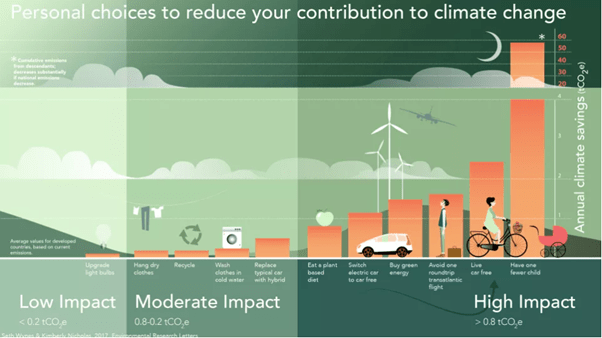
Reducing greenhouse gas emissions is one of the most effective ways individuals can combat climate change. While governments and industries play a massive role in shaping policies and technologies, personal choices matter too. From diet and transport to home heating and even family planning, our daily decisions have a direct impact on our carbon footprint.
In 1990, UK emissions were ~14 tonnes CO₂ per person per year. The UK has set an ambitious but achievable target to reduce greenhouse gas emissions by at least 81% by 2035, compared to 1990 levels. This is part of the UK’s Nationally Determined Contribution (NDC) under the Paris Agreement, aiming to keep global warming below 1.5°C. An 81% reduction means the target for 2035 is ~2.7 tonnes CO₂ per person per year.
We thought it might be interesting to explore three major ways to reduce emissions at the domestic level and compare this with something almost never openly discussed: the impact of having children. We’ve tried to quantify the effects of each, and rank them by impact.
1. Food Choices: Rethinking the Dinner Plate
Food production is responsible for a large portion of global emissions. In fact, food production accounts for around 26% of global greenhouse gas emissions. This includes emissions from:
- Livestock & fisheries (~31% of food-related emissions)
- Crop production (~27%)
- Land use changes (~24%)
- Supply chain activities (~18%)
Some estimates suggest food systems contribute up to one-third (34%) of global emissions when including processing, packaging, and transport.
If we just look at the UK, agriculture (which includes food production) is responsible for around 12% of total greenhouse gas emissions. This includes:
- 70% of total nitrous oxide emissions (from fertilizers)
- 49% of total methane emissions (from livestock)
- 2% of total carbon dioxide emissions (from machinery and land use)
At the individual level, livestock farming and land use driving much of the impact. While many people and families choose to be vegetarians or vegans it’s not necessary to fully embrace a vegetarian or vegan diet. For example, cutting out meat during the week, but not at the weekend still have a major impact. Here’s a comparison between the diet choices:
| Diet Type | Estimated CO2 Emissions (tonnes/year per person) |
| Full meat-based diet | ~2.5 |
| Weekday vegetarian, weekend meat (80% chicken, 20% beef) | ~1.4 |
| Vegetarian diet | ~1.3 |
| Vegan diet | ~0.9 |

The takeaway from this is that switching to a vegan diet saves ~1.6 tonnes CO2 annually per person—a 64% reduction compared to a meat-heavy diet. However, you can save over a tonne by reducing you beef intake
Beef emits ~25 kg CO₂-equivalent per 100g
Chicken emits ~4.3 kg CO₂-equivalent per 100g
2. Transport: Ditching Fossil Fuels on the Road
Personal vehicle emissions are a major contributor to climate change. Transport is responsible for about 23% of global energy-related CO₂ emissions. Road transport accounts for 70% of these emissions, while aviation and shipping contribute 12% and 11%, respectively. It’s the biggest source of emissions in the UK at 29% in 2023, despite having reduced by 11% since 2019.
The good news? Switching to public transport, electric cars, or cycling makes a huge difference.
- Petrol car (average UK driver): ~2.4 tonnes CO₂ per year
- Electric car (UK grid mix): ~0.8 tonnes CO₂ per year
- Electric car (Green tariff): 0 tonnes CO₂ per year
- Public transport & cycling: ~0.5 tonnes CO₂ per year. Cycling may be lower, but the additional calorie consumption may pull through additional food consumption. See above!

Switching to public transport or walking, where these are practical, saves ~1.9 tonnes CO₂ per household annually, cutting emissions by 79%. However, an EV coupled with zero carbon electricity is better still, saving the full 2.4 tonnes (through doesn’t help with traffic congestion).
3. Home Heating: The Overlooked Climate Solution
Households account for ~26% of UK emissions while domestic heating accounts for about 75% of household gas use in the UK, making it one of the biggest factors in domestic emissions. Again, this has seen some decrease, down 6.2% in 2023. However, the numbers are still worrying if we are to get down to that 2.7 tonnes per person.
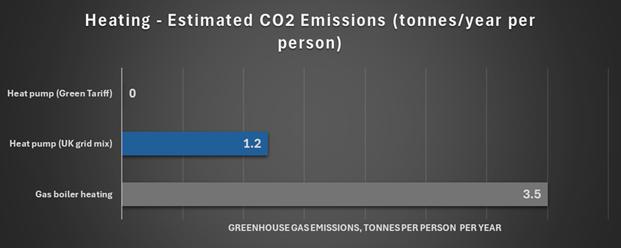
- Gas boiler heating: ~3.5 tonnes CO2 per household per year
- Heat pump (UK grid mix): ~1.2 tonnes CO2 per household per year,
- Heat pump (Green Tariff): ~0 tonnes. Alternatively, a modest 4kWp solar panel system would reduce heat pump emissions by ~50–75%.
Switching to a heat pump saves ~2.3 tonnes CO2 annually per household, a 66% reduction, or more if the right tariff is selected.
4. Family Planning: The Biggest Long-Term Impact
So now we come to the contentious option. While personal lifestyle choices reduce emissions immediately, family planning has the largest long-term impact on global emissions. That’s because each person contributes around 14 tonnes of carbon emissions per year; however this is compounded because people tend to make more people. The cumulative impact of current and future descendants for all emissions produced over the lifespan of descendants, divided by the life expectancy of each parent gives us a much larger number… 58 tonnes per additional child.
Each additional child adds ~58 tonnes CO₂ per year (lifetime average).
The maths is pretty obvious; having one fewer child is the single biggest factor in reducing household carbon emissions.
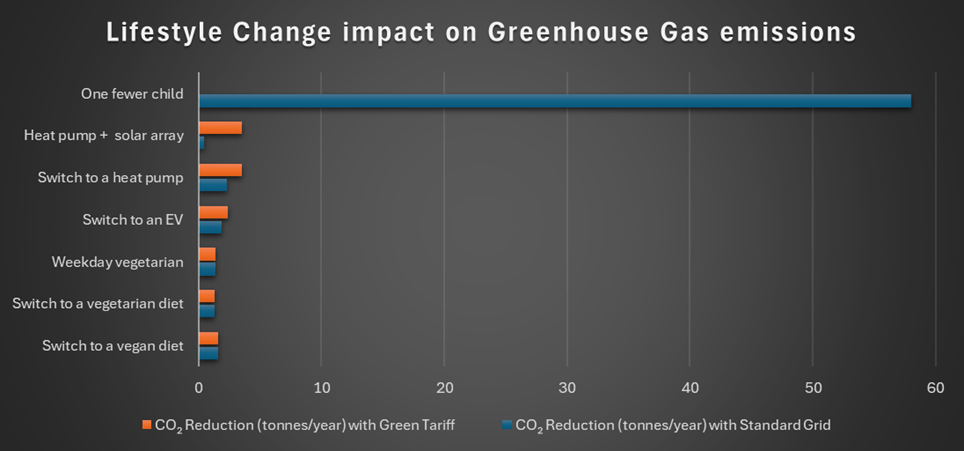
Comparing the Impact of Each Action
| Lifestyle Change | CO₂ Reduction (tonnes/year) with Standard Grid | CO₂ Reduction (tonnes/year) with Green Tariff |
| Switching to a vegan diet | 1.6 (per person) | 1.6 (per person) |
| Switching to a vegetarian diet | 1.3 (per person) | 1.3 (per person) |
| Weekday vegetarian, weekend meat (80% chicken, 20% beef) | 1.4 (per person) | 1.4 (per person) |
| Switching to an EV (whole household) | 1.9 | 2.4 |
| Switching to a heat pump (whole household) | 2.3 | 3.5 |
| Switching to a heat pump + 4kWp solar array | 0.3–0.6 | 3.5 |
| Having one fewer child (household impact) | 58 | |
Final Thoughts
There are many lifestyle changes that can contribute to lowering emissions. This analysis hasn’t considered recycling, for example. Meanwhile, avoiding one transatlantic flight saves ~1.6 tonnes CO₂ per person and one European flight saves ~0.3 tonnes CO₂ per person. That notwithstanding, the choices discussed have significant impacts.
- Diet, transport, and heating choices immediately cut personal carbon footprints.
- Family planning decisions shape the long-term environmental impact at a much larger scale.
The decisions individuals and families choose to do make a difference; collectively the difference is large. Those decisions are morally theirs to make. The purpose of this article is simply to provide some insights into the scale of some impacts.
Small shifts add up, and collectively, they create waves of impact that ripple through generations.
This isn’t about perfection—it’s about action. The path to a lower-carbon world starts with the decisions we make today.
References:
Environmental Impacts of Food Production https://ourworldindata.org/environmental-impacts-of-food
Food systems account for over one-third of global greenhouse gas emissions https://news.un.org/en/story/2021/03/1086822
Balancing UK agricultural production and environmental objectives https://post.parliament.uk/balancing-uk-agricultural-production-and-environmental-objectives/
IPCC Sixth Assessment Report https://www.ipcc.ch/report/ar6/wg3/chapter/chapter-10/
2023 UK greenhouse gas emissions https://assets.publishing.service.gov.uk/media/6604460f91a320001a82b0fd/uk-greenhouse-gas-emissions-provisional-figures-statistical-release-2023.pdf
Climate change insights, families and households, UK: August 2022 https://www.ons.gov.uk/economy/environmentalaccounts/articles/climatechangeinsightsuk/august2022
The four lifestyle choices that most reduce your carbon footprint https://www.lunduniversity.lu.se/article/four-lifestyle-choices-most-reduce-your-carbon-footprint

