Why land area only matters when you count all the land that energy really uses
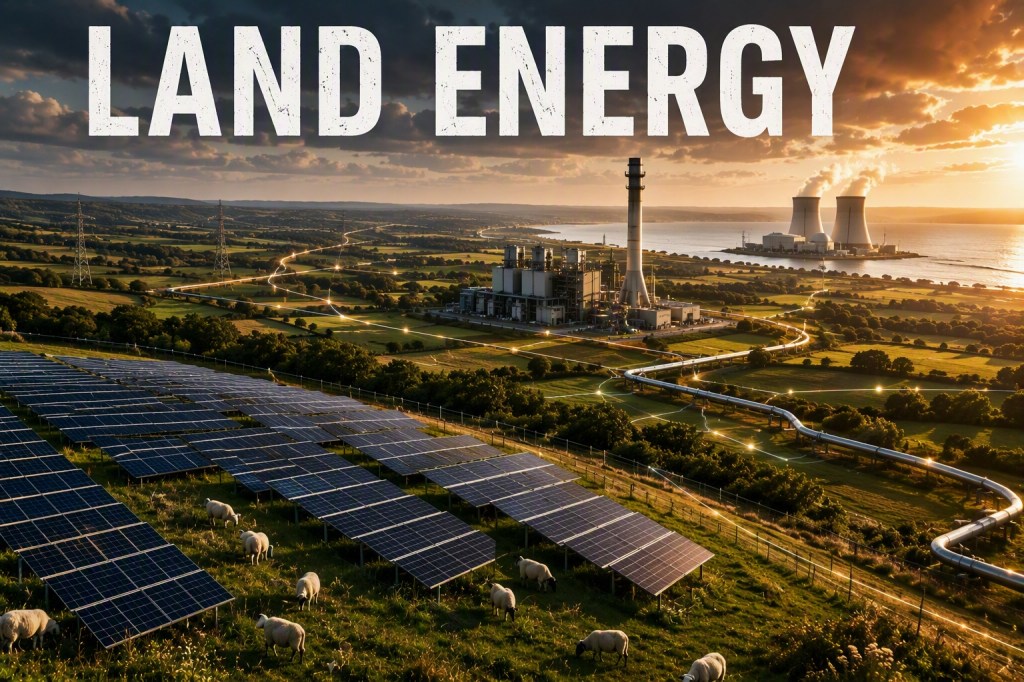
Arguments about land use in energy often begin with a photograph and end with a conclusion. A gas-fired power station occupies a compact industrial site. A nuclear station sits within a relatively small, well-defined boundary. A solar farm spreads across fields, while wind turbines may be visible across an entire landscape. From the fence line, the answer appears obvious: conventional generation is compact, while renewables are land hungry.
The observation is real, but the conclusion is often misleading because it counts only the land that can be seen. Modern energy systems are not simply power stations; they are supply chains. Every source of electricity requires some combination of mining, processing, transport infrastructure, maintenance, waste handling and eventual decommissioning. Looking only at the generating facility ignores much of the land required to support it.
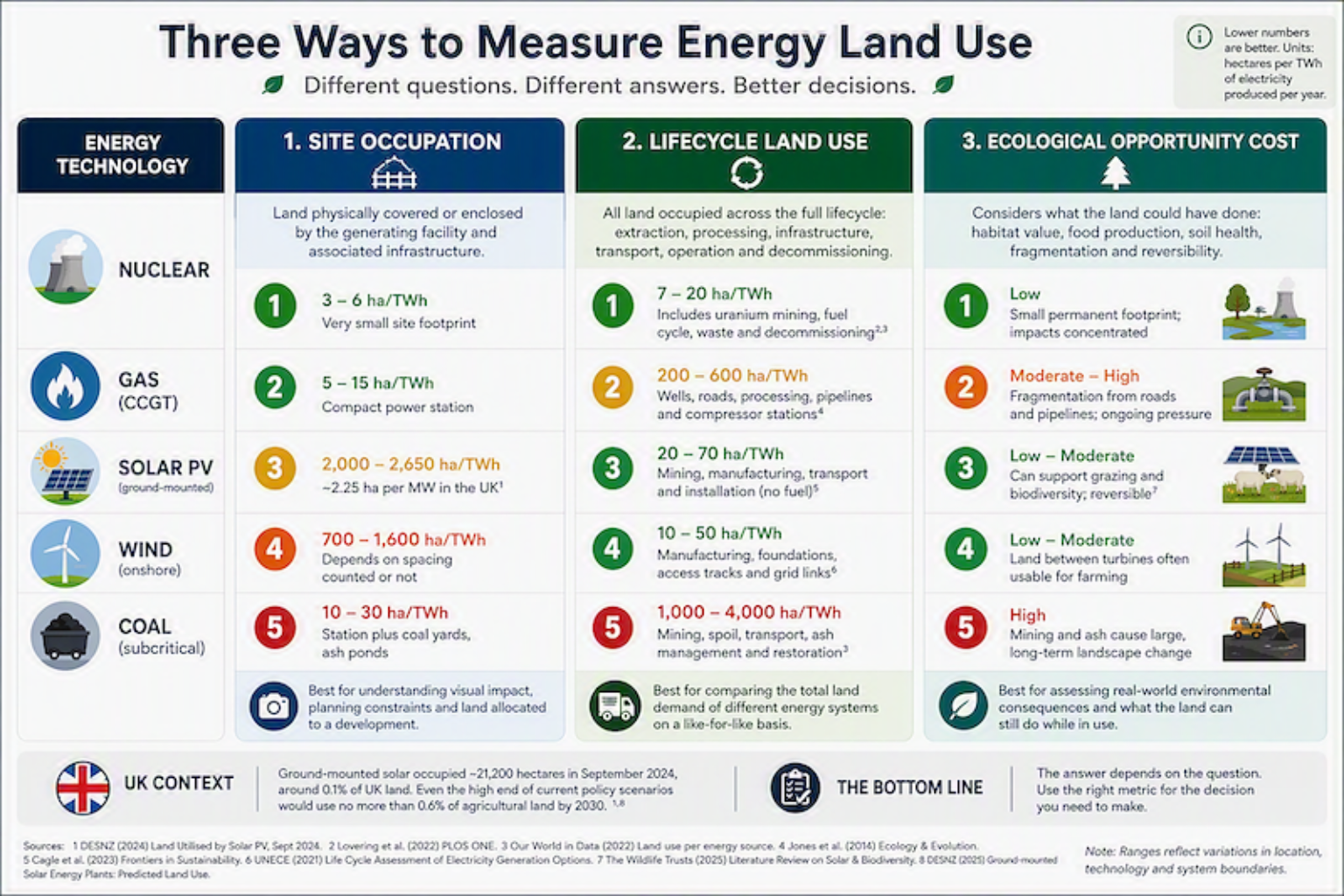
This creates a problem in public debate. People often talk about “land used by energy” as though it were a single, obvious measure. In reality they are usually discussing one of three very different things. The first is the land physically occupied by the generating facility. The second is the land occupied throughout the entire lifecycle of producing a unit of electricity. The third is the ecological opportunity cost of that occupation: what other functions that land can still perform while the energy system is present.
All three questions are legitimate. None can safely be substituted for another.
The fence-line view
If the discussion is restricted to the generating site itself, then gas and nuclear perform exceptionally well.
A modern combined-cycle gas turbine plant can produce very large quantities of electricity from a remarkably compact site. Nuclear stations achieve something similar through the extraordinary energy density of uranium and their high utilisation rates. Ground-mounted solar, by contrast, requires substantially more surface area.
The Department for Energy Security and Net Zero estimated that, at the end of September 2024, ground-mounted solar installations occupied around 21,200 hectares across the United Kingdom, representing approximately 0.1% of the nation’s total land area. Typical projects occupy around 2.25 hectares per megawatt of installed capacity, although individual sites vary significantly.
These figures often appear in criticisms of solar farms, but it is important to be clear about what they mean. They describe the area contained within the solar development boundary. They do not describe the total land required to provide solar electricity, nor do they describe land that has necessarily been removed from all other uses.
This distinction becomes obvious when nuclear is added to the comparison.
One of the most comprehensive studies of electricity land use examined around 1,400 observations across 73 countries and 45 US states. It found nuclear to be the most land-efficient source of electricity generation in its dataset, with a median land-use intensity of approximately 7.1 hectares per terawatt-hour generated annually. That made nuclear dramatically more land efficient than ground-mounted solar and significantly more land efficient than coal.
If the question is simply “which technology generates the most electricity per hectare of generating site?”, nuclear wins and gas performs extremely well. On that narrow metric, critics of solar farms are broadly correct.
The problem is that this metric only captures the final stage of the energy system.
Looking beyond the power station
Once the boundaries are expanded beyond the generating facility, the picture becomes much more nuanced.
Gas generation depends upon a continuing industrial landscape that extends well beyond the power station itself. Every unit of electricity requires gas to be extracted, processed, compressed, transported and ultimately burned. This requires wells, gathering systems, access roads, processing plants, compressor stations and pipelines, many of which extend across large geographic areas.
The generating station may remain small, but the supporting infrastructure does not.
Research into natural gas infrastructure has demonstrated why this wider perspective matters. One study found that roads and pipelines accounted for more than a third of the directly affected habitat footprint associated with gas extraction activities. The authors concluded that these linear features should be considered alongside extraction facilities when assessing environmental impact because they contribute significantly to habitat fragmentation.
This does not mean gas suddenly becomes the worst-performing technology. It does mean that comparing the complete fenced area of a solar farm with only the turbine hall of a gas station is not comparing like with like.
Nuclear tells a different story. Like gas, nuclear has upstream requirements that are invisible from the generating site. Uranium must be mined, processed, enriched and manufactured into fuel. Nuclear facilities must eventually be decommissioned, and wastes must be managed for the long term. Yet even when these stages are included, nuclear remains one of the most land-efficient energy technologies available.
Solar presents the opposite pattern. Manufacturing panels requires materials, mining and factory infrastructure, but once the system is built there is no ongoing fuel extraction. No wells have to be drilled. No pipelines have to be maintained. No raw fuel has to be supplied throughout the next thirty or forty years of operation. Most of the lifecycle impact occurs before operation begins.
Not all hectares are equal
Even lifecycle land occupation does not tell the whole story.
A hectare occupied by a solar farm is not necessarily equivalent to a hectare occupied by a mine, a gas field, a road corridor or an industrial estate. The crucial question becomes not simply how much land is occupied, but what remains possible on that land while the energy system is present.
This is where ecological opportunity cost becomes important.
A wind farm may extend across a large geographic area, yet much of the intervening land remains available for agriculture. A solar farm may support sheep grazing, species-rich grassland, improved hedgerows and pollinator habitat. A gas pipeline corridor may occupy a comparatively small total area while simultaneously fragmenting habitats across a much wider landscape. A surface mine may transform ecosystems entirely.
The difference between land occupied and land lost is therefore critical.
So what is the right comparison?
The mistake in many energy debates is to use one metric for one technology and a different metric for another. Solar farms are usually assessed by counting every hectare within their development boundary. Gas power stations are often assessed only by counting the power station itself. Wind farms are frequently criticised using their entire spacing area, while coal stations are discussed without reference to the mines that feed them.
None of these comparisons are fair.
The correct approach is to apply the same system boundary to every technology. Either count only the generating facility for all technologies or count the full lifecycle for all technologies. Either focus on site occupation or focus on ecological outcomes. Mixing the approaches inevitably produces misleading results.
The useful question is not “How much land can I see?” but “How much land does the entire energy system occupy, for how long, and what can that land still do?”
Once those questions are separated, land use becomes a meaningful environmental metric rather than a convenient photograph.
Sources
- Lovering et al. (2022) Land-use intensity of electricity production and tomorrow’s energy landscape, PLOS ONE.
- Ritchie (2022) How does the land use of different electricity sources compare?, Our World in Data.
- Department for Energy Security and Net Zero (2024) Land Utilised by Solar PV.
- Department for Energy Security and Net Zero (2025) Ground-mounted Solar Energy Plants: Predicted Land Use.
- House of Commons Library (2025) Planning for Solar Farms.
- UNECE (2021) Life Cycle Assessment of Electricity Generation Options.
- Gibon (2022) Corrigendum to UNECE Integrated Life-cycle Assessment of Electricity Sources: Land Use.
- Jones et al. (2014) Quantifying Habitat Impacts of Natural Gas Infrastructure to Facilitate Biodiversity Offsetting.
- The Wildlife Trusts (2025) Impacts of Ground Mounted Solar Farms on Biodiversity.
- Cagle et al. (2023) Standardized Metrics to Quantify Solar Energy-Land Relationships.


