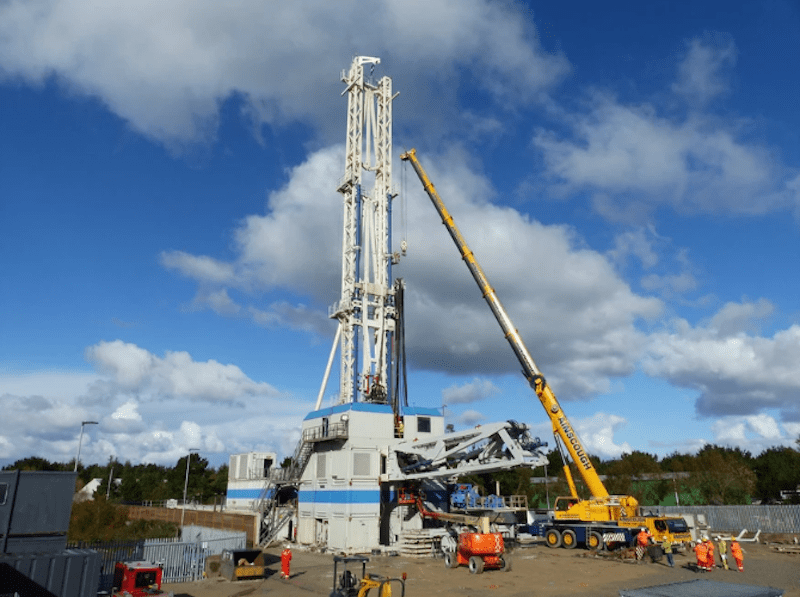
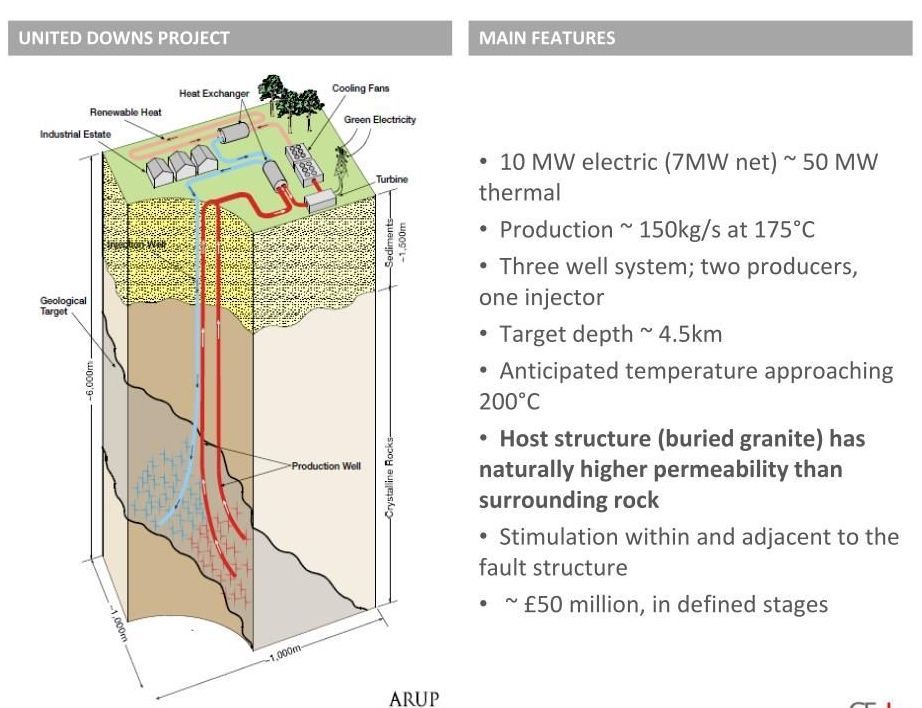
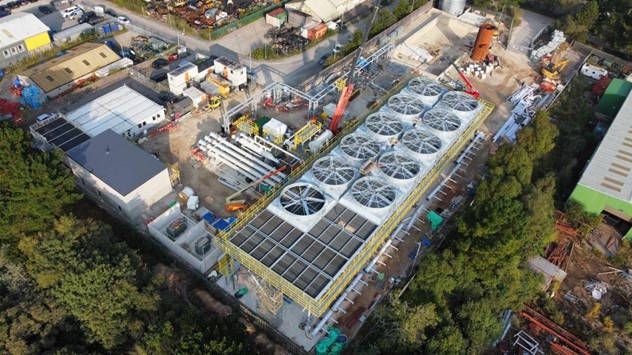
The United Downs Deep Geothermal Power project in Cornwall is the UK’s first commercial deep‑geothermal electricity plant. It taps hot granite more than 5 km below ground, using an Organic Rankine Cycle (ORC) plant to generate around 3 MW of continuous baseload electricity, enough to power roughly 10,000 homes.
It also co‑produces around 100 tonnes per year of lithium carbonate from the same geothermal brine, providing a vlauable source of lithium for batteries and other indstrial application. This positions the facility as both a power plant and a critical‑minerals asset. The geothermal power project uses only a small amount of land to produce electricity with a relatively low carbon footprint of 5g – 15g of CO2 per kW. There is the option to use the surplus heat for local industry, agriculture, or space heating.
- Output: ~3 MW electrical, 24/7 baseload
- Capacity factor: ~90–95% (designed as continuous operation)
- Homes powered: ~10,000 equivalent
- Co‑product: ~100 t/year lithium carbonate
Putting this into perspective
3MW and 10,000 homes sounds like a lot, but let’s explore this.
There are ~30,000,000 homes in the UK, so this is just 0.036%. Likewise, the UK has about 115GW of installed generation capacity, so this is just 0.0026% of that. So, not so big.
At 0.0026% of UK installed generation capacity it’s not so big.
However, it’s an important development for several reasons, not least because it’s predicatable, stable, long term and low carbon. It’s the first deep‑geothermal power plant in UK history, and acts as a pilot for the technology. It proves the geology, the drilling methods, the ORC plant design, and the lithium extraction.
Unlike wind or solar, it runs at ~95% capacity factor, so its effective contribution is much larger than its nameplate rating suggests. More on this ‘Firm power’ later. It also acts as a a template for a future geothermal fleet of similar geothermal plants.
United Downs offers ‘firm’ power, actively displacing the need for gas peaker plants
Although these types of plant are small at a national scale, they can be transformational regionally and are extremely valuable as firm winter power.
Firm power generators like these actively displaces gas at the margin. MW of firm low‑carbon power reduces the need for gas‑fired backup, so called ‘peaker plants’, the UK’s biggest remaining source of grid emissions.
Is it safe?
Some people are concerned that there may be risks associated with geothermal plants, exacerbated by the media reporting of the consequences of fracking.
It turns out that the concern is partly reasonable, but the risks are much smaller and better controlled than those associated with fracking. The Cornwall project does induce small seismic events, but these are very low‑magnitude, well‑monitored, and expected within the design of deep geothermal systems.
- The United Downs geothermal plant injects and circulates water through natural fractures in granite several kilometres underground. This process can lubricate faults and trigger micro‑earthquakes, i.e. below magnitude 2.0.
- During drilling in 2020, the project induced 15 tremors all below magnitude 1.5, which residents described as window‑rattling but not damaging.
- Scientists and the operator (GEL) openly acknowledge this “induced seismicity” as an inherent part of deep geothermal engineering.
This is different to fracking, which involves high‑pressure injection to deliberately fracture rock, which can activate faults more abruptly and unpredictably, e.g., magnitude 2.9 at Preston New Road. Deep geothermal in Cornwall uses lower pressures and relies on existing fractures, making seismic events smaller and more controlled.
What about embedded carbon?
Low cost, low carbon generation is great, but what about all the energy and carbon in drilling and running the plant?
Several features of the project strongly shape its carbon profile:
- High upfront embodied carbon from drilling two of the deepest wells ever drilled in the UK (down to ~5 km) and installing an Organic Rankine Cycle plant. This is a more carbon‑intensive build than wind or solar.
- Very low operational emissions because it produces 24/7 baseload electricity with no combustion and minimal surface footprint.
- Co‑production of lithium may improve the overall carbon balance by displacing higher‑carbon lithium imports, but this does not directly shorten the electricity‑generation payback period.
Deep geothermal projects internationally typically show carbon payback times of 1–8 years, depending on drilling depth, flow rate, and plant efficiency. As a pilot project, United Downs sits at the deeper, more complex end of this spectrum, so its payback is likely toward the upper part of that range, but still well within a single decade.
This is initialy higher than other renewables. Solar PV has a carbon payback of 1–3 years for UK conditions. Onshore wind turbines have relatively low embodied carbon and high energy yield, so the carbon payback is 6 months to 1 year.
However, because the geothermal plant runs at ~96% capacity factor (far higher than wind or solar), its lifetime carbon intensity becomes very low once the initial embodied carbon is repaid.
Geothermal runs at ~96% capacity factor, far higher than wind or solar. The lifetime carbon intensity is very low
What did it cost?
The United Downs geothermal plant cost about £50 million to develop, including drilling two deep wells (one to 5.2 km), surface plant construction, and the lithium extraction demonstration facility. That 3 MW at 95–98% capacity factor yields roughly 25–26 GWh per year. A plant like this can operate for 30–50 years or more.
UK wholesale electricity prices have been volatile, but long‑term PPAs (Power Purchase Agreements) for firm renewable power typically fall in the £70–£120/MWh range depending on contract timing and risk. Using a mid‑range PPA price of £90/MWh:
- Annual electricity revenue ≈ 26 GWh at £90 = £2.3 million/year
At that rate, ignoring O&M costs and lithium revenue, simple payback would be ~22 years from electricity only. If lithium carbonate sells at even a modest £5,000–£8,000 per tonne (well below peak prices) that’s an extra £0.5–£0.8 million/year.
Combined revenue is £2.8–£3.1 million/year, which brings simple payback to roughly 16–18 years, less with higher electricity prices or improved flow rates.
How this compares with other renewables
| Technology | Typical capital cost | Capacity factor | Simple economic payback |
| Onshore wind | Low–moderate | 30-40% | 6-10 years |
| Solar PV (grid scale) | Low | 10-12% | 8-12 years |
| Deep geothermal (United Downs) | High (drilling-dominated) | 90–98% | 12–22 years depending on PPA price and lithium revenue |
Geothermal is capital‑intensive up front but produces continuous, dispatchable, fossil‑free baseload power, which gives it a different economic profile from intermittent renewables.
Let’s build more
Why not take the learning from this first geothermal plant anf build an entire fleet of similar plants? Is it possible, how manh shouodwe build and ae here economies of scale?
A plausible Cornwall‑plus fleet
Cornwall’s granite batholith and a handful of other UK hot‑rock or deep‑aquifer regions (e.g. parts of Devon, Weardale, some sedimentary basins) could realistically host dozens of deep‑geothermal wells, but only a subset will be suitable for power generation rather than just heat. Realistiically a power‑focused fleet might look like:
- 10–20 plants of 3–5 MW each in Cornwall and nearby granites
- Additional clusters (say another 5–10 plants) in other favourable regions
Collectively that yields something like:
- 50–150 MW of firm geothermal capacity in Cornwall
- 100–300 MW UK‑wide if other basins are developed
Even this many only provides a modest generation contribution to the grid. It’s not the same scale as a nuclear power plant, but it is absolutely grid‑relevant, especially as firm capacity in regions with high wind and solar penetration.
Cost per MW as the fleet scales
United Downs is a first‑of‑a‑kind plant, with high drilling and learning costs, deep‑geothermal projects are relatively expensive because:
- Drilling is exploratory and slow.
- Subsurface risk is high and priced into finance.
- Surface plant design is bespoke.
But as you scale out Drilling costs fall (better bit choice, mud programmes, local expertise), Surface plant costs fall (standardised ORC modules, repeatable layouts) and Financing costs fall (resource risk is better understood, lenders more comfortable).
It’s reasonable to expect unit costs to fall from £15–20 m/MW at pilot to a mature fleet cost around £8–12 m/MW. A 5 MW plant might cost £40–60 million once the learning curve is climbed.
Why we should do it anyway
Firm energy vs. intermittent energy are not equal. A firm kWh is one you can rely on any hour of the day, any day of the year, regardless of weather.
Geothermal, nuclear, hydro with reservoirs, and gas plants produce firm kWh. Solar and wind produce non‑firm kWh: cheap, clean, but dependent on weather and season. United Downs is explicitly designed as 24/7 baseload, selling constant power under a long‑term contract to Octopus Energy. Every kWh it generates is, by definition, firm.
Intermittent renewables (solar, wind) are superb at reducing annual fossil‑fuel burn, but they drop sharply in winter (solar), fluctuate with weather (wind), often produce surpluses at times of low demand.
The reality is that to turn intermittent kWh into firm kWh, you need:
- Overbuild (more capacity than average demand)
- Storage (batteries, pumped hydro, etc.)
- Grid reinforcement
- Curtailment management
All of that adds cost. So while the raw LCOE of solar and wind is low, the system cost per firm kWh is much higher.
Geothermal, by contrast, needs no seasonal storage or no overbuild. It uses grid connections at very high utilisation and provides predictable, dispatchable output. So even if its LCOE is higher than solar’s, its system value per kWh, especially in winter, is much greater.
What a geothermal fleet could contribute to the UK transition
Let’s take a not‑crazy scenario:
- 20 geothermal plants × 5 MW = 100 MW firm capacity
- Capacity factor ~90% → ~790 GWh/year
Provides enough to power ~300,000 homes at typical UK consumption, i.e. 1% of all households. That’s a non‑trivial contribution to national firm low‑carbon capacity.
A large fleet of deep‑geothermal plants in the UK could deliver hundreds of MW of firm, low‑carbon capacity. The cost per MW should fall significantly as drilling and plant design standardise, with the benefis mentioned above.
- Every geothermal kWh is a firm kWh, which is inherently more valuable to the grid than an intermittent kWh from solar or wind.
- In a high‑renewables system, firm geothermal acts as a stabilising backbone in regions where it’s available, reducing reliance on gas‑fired backup and expensive storage.
United Downs is a first of a kind, proof of concept, generating meaningful and reliable energy to the UK grid, with the bonus benefit of delivering consistent aggressive Lithium.
Scaled out, now we understand the economic and geophysical realities, a fleet of such plants in suitable locations could provide another step towards a sustainable, reliable, carbon free grid. Combine that with renewables and demand side management and we can close to NetZero.
Sources
United Downs
https://www.thriverenewables.co.uk/projects/united-downs-geothermal
https://energydigital.com/news/the-story-of-the-uks-first-ever-geothermal-power-plant
https://en.wikipedia.org/wiki/United_Downs_Deep_Geothermal_Power


One response to “From pilot to fleet – scaling Cornwall’s deep geothermal and the value of firm power”
[…] Downs’ 3 MW plant discussed in our previous article is often described as “powering 10,000 homes.” That invites a natural […]
LikeLike