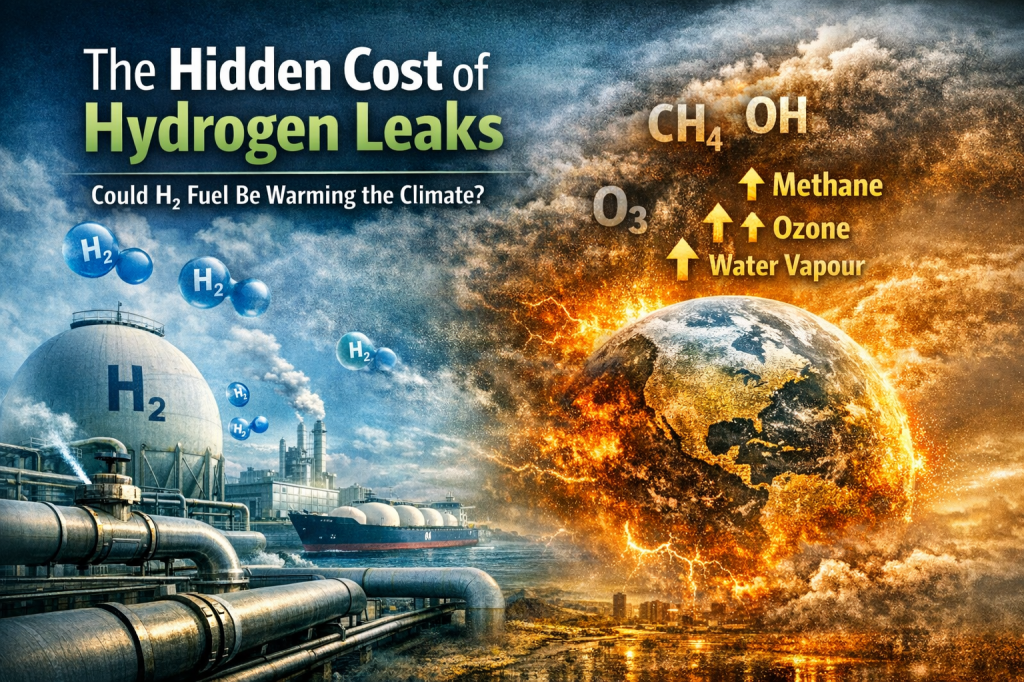
Hydrogen has a reputation for being the cleanest fuel we can make. It burns without CO₂ and looks, on the surface, like an obvious part of a low‑carbon future.
But there’s a problem the industry tends to gloss over:, one that scientists at MIT, Stanford and Oxford are losing sleep over: Hydrogen leaks.
It leaks through steel pipelines. It escapes through seals that retain other gases without problem. It diffuses at triple the rate methane diffuses.
Hydrogen Leaks
And when it does, the atmospheric chemistry becomes far less benign.
Hydrogen isn’t a greenhouse gas in its own right, but it’s the smallest molecule there is. Even small weaknesses in manufacture, transmission and storage become meaningful losses. Current estimates put leakage across the supply chain somewhere between 1% and 10%. That’s with good, sealed transmission pipes.
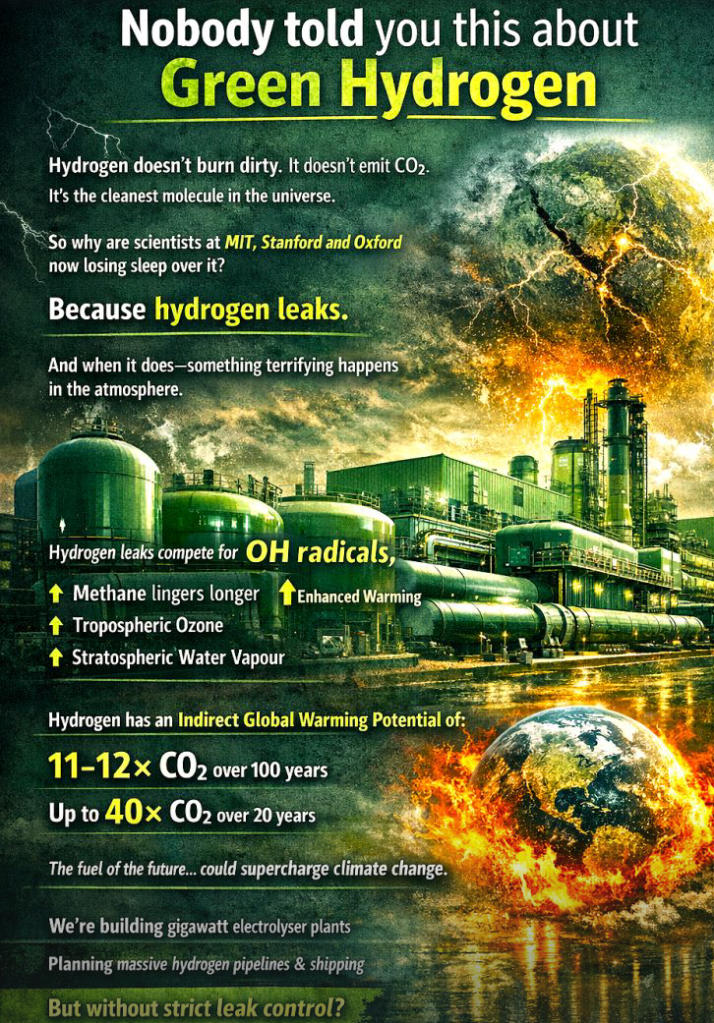
The real issue is what happens once that hydrogen reaches the atmosphere. It competes with methane for hydroxyl (OH) radicals; the reactive species that normally break methane down. If hydrogen ties up preferentially scavenges the OH radicals it means methane isn’t being removed so persists for longer, amplifying its warming effect. At the same time, tropospheric ozone increases and stratospheric water vapour rises, both of which add further warming effects.
Leaking hydrogen accentuates methane’s impact
Taken together, leaked hydrogen carries an indirect global warming potential of roughly 11–12 times CO₂ over 100 years.
This doesn’t mean green hydrogen is a mistake. If leakage is kept extremely low, it remains far better than fossil fuels (though markedly less efficient than pure electric). However, it does mean the sector has a worrying blind spot. We’re scaling up electrolysers, pipelines and shipping routes at extraordinary speed, yet leakage detection and regulation are barely on the radar, certainly nowhere near the level they need to be.

If hydrogen is going to be genuinely green, we have to treat leakage as seriously as we treat CO₂ emissions. A green hydrogen economy only works if we manage leakage with the same seriousness we apply to CO₂.
Hydrogen can still be a powerful decarbonisation tool. It just can’t be allowed to escape into the atmosphere unchecked.
Conclusion
- Methane stays in the atmosphere longer
- Methane’s warming effect is amplified
- Tropospheric ozone increases
- Stratospheric water vapour builds up
The net effect: Hydrogen carries an indirect Global Warming Potential of 11–12× CO₂ over 100 years. The fuel we are racing to produce at gigawatt scale is a more potent warming agent than the fossil fuels it replaces if not handled with far more care and and understanding than we are currently applying.
References
Climate benefit of a future hydrogen economy
https://www.nature.com/articles/s43247-022-00626-z
The Hydrogen Stream: UK scientists call for strict rules for H2 leakage
https://isa-ghic.org/the-hydrogen-stream-uk-scientists-call-for-strict-rules-for-h2-leakage
Hydrogen emissions are ‘supercharging’ the warming impact of methane
With thanks to Sanjeev Sharma for the insights and infographic 2
https://www.linkedin.com/in/sanjeevsharmagh2
 Sustainable Ferriby